
E‑470 director outlines widening, toll allocations and customer service upgrades
Get AI-powered insights, summaries, and transcripts
Subscribe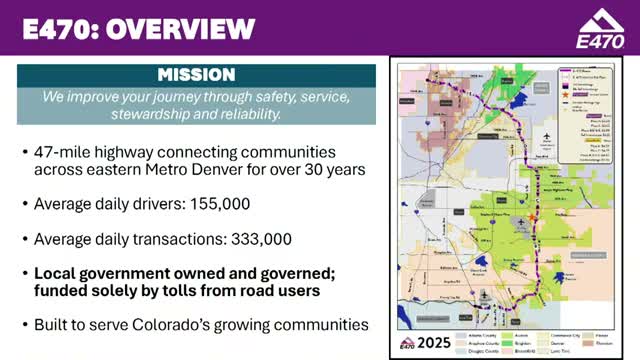
Summary
E‑470 Executive Director Joe Donahue told Commerce City Council the toll authority is self‑funded, plans to widen sections to six lanes and pursue interchanges at 88th and 112th avenues, and is investing in improved plate reading and customer dispute tools.
Joe Donahue, executive director of the E‑470 Public Highway Authority, told Commerce City’s City Council Dec. 1 that the tolled outer beltway is locally owned, self‑funded and preparing for further widening and interchange work to meet regional growth.
Donahue said E‑470 now averages about 155,000 drivers and roughly 333,000 toll transactions per day. He described how toll revenue is allocated: roughly 28 cents of every toll dollar goes to debt service, about 20 cents to operations and maintenance, and the remainder is reinvested in the highway. Donahue said the authority still carries about $1.2 billion in outstanding debt tied to the original build‑out and that the agency has already reinvested more than $2.5 billion into the corridor since it opened.
He outlined near‑term construction plans, including recently completed widening to 104th Avenue and a contractor scheduled to begin work next year to widen the section from 104th to US‑85 to six lanes; subsequent widening toward I‑25 also is planned. Donahue identified interchange projects in Commerce City as priorities, including a half‑diamond at 88th Avenue and a future full interchange at 112th Avenue when traffic volumes and funding allow.
On customer service and technology, Donahue said E‑470 is moving to improved license‑plate reading accuracy, an advanced traffic management system that flags incidents, and a redesigned ExpressToll website (expected in 30–60 days) that will let customers view transactions, images and dispute billing online. He also described efforts to reduce billing errors caused by plate misreads and cited a national security initiative that helped disrupt a smishing campaign aimed at customers.
Council members asked about trail connections, whether residents or trucks receive toll discounts and timing for the Sabal project; Donahue said the authority is building trails incrementally with jurisdictions, offers limited off‑peak truck discounts to shift freight away from peak times, and expects Sabal to open next year. He said discount programs and long‑term toll reductions depend on long‑term financing strategies.
The presentation emphasized that E‑470 is governed by member counties and cities and is not a private operator.