
District panel and clinician offer step-by-step strategies to help students with school anxiety
Get AI-powered insights, summaries, and transcripts
Subscribe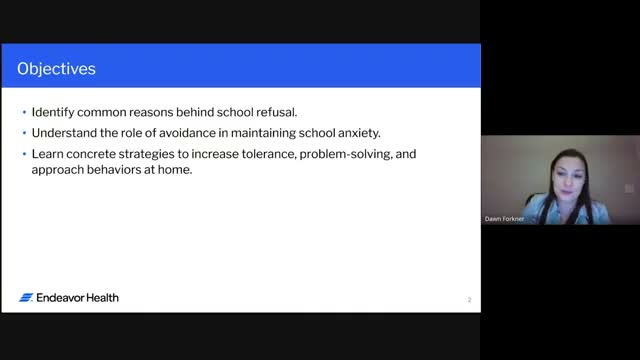
Summary
At a Parent University for Indian Prairie CUSD 204, Dr. Laura Koehler and district staff described why school refusal is usually anxiety-driven, demonstrated the STOP skill and grounding exercises, and urged coordinated home–school routines, soft-starts at school entrances and treating absences as sick days rather than rewards for avoidance.
Indian Prairie CUSD 204 held a Parent University session on school anxiety in which Dr. Laura Koehler of Endeavor Health Linden Oaks and a panel of district staff outlined practical steps families and schools can take when children avoid school.
"School refusal is not defiance. It's an avoidance driven by distress," Koehler said, framing avoidance as a short-term coping response that can weaken long-term resilience. She described school refusal as an "iceberg" — visible behaviors such as crying or refusing to enter school that rest on hidden causes like separation anxiety, social fears, test anxiety, executive-function challenges, sensory overload and family stress.
Koehler explained the "avoidance loop," in which staying home reduces anxiety in the moment and therefore reinforces future avoidance, and contrasted it with an "approach loop" that builds confidence through repeated, values-based practice. "Avoidance is a coping strategy," she said. "Approaching it builds resilience and confidence."
She introduced the STOP framework (Stop, Take a breath/Observe, Proceed mindfully) as a quick way to interrupt impulses to avoid, and demonstrated classroom-friendly grounding tools including the 5-4-3-2-1 sensory exercise, short puzzles or cognitive tasks, progressive muscle relaxation, the "star" stretch and paced breathing (4-7-8). Koehler recommended daily regulation measures — consistent sleep, limiting mood-altering substances including caffeine and energy drinks, regular activity and predictable routines — to lower baseline anxiety.
District staff then answered submitted questions from parents. On explaining academic consequences, Laurie from Still Middle School and Jill Keller, principal at Georgetown Elementary School, recommended age-appropriate role-playing and cause-and-effect conversations so younger students can see how missed assignments pile up. Saralise, the SEL coach at McCarty Elementary School, emphasized role-play for younger children.
When a child refuses to get on the bus or out of the car, Amanda Pisac, mental-health coordinator at Metea Valley High School, recommended "soft starts" (meeting students at a quieter door, inviting them into an office for a brief check-in) and daily check-ins with a trusted staff member to escort them to class. "So it should truly be treated as a sick day," Pisac said, urging parents not to make being at home more attractive than school. She also noted that the district allows five mental-health days for students and urged families to reserve those for genuine mental-health needs.
On routines, staff said parents should set clear bedtime and screen rules; for high school students, natural academic consequences (missed quizzes, truancy processes) can be effective motivators. On peer conflict and bullying, panelists encouraged reporting to deans and house teams and described options such as alternative lunch spaces, pass runners and no-contact interventions.
The session closed with resources Koehler recommended (workbooks for children and parenting books) and an emphasis on combining home strategies, school supports and, where appropriate, outpatient therapy. The event ended after the Q&A; organizers thanked participants and closed the session for the evening.