Delray Beach staff outlines road-repair plan after PCI shows citywide ‘low C’ condition
Loading...
Summary
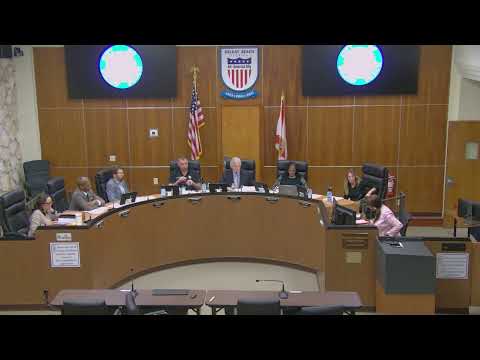
Public Works Director Missy Barletto told the commission Dec. 1 that Delray Beach’s Pavement Condition Index is 55.6 (a low C), with roughly 17 miles below a 50 rating and estimated repair costs totaling millions; staff recommended a phased, preservation-first approach as prior surtax funding has ended.
Delray Beach’s public works director on Dec. 1 told the City Commission that the city’s roads have improved from a prior D/F range but still need sustained investment to avoid steep future costs.
“Right now, our overall PCI rating in the city is a 55.6,” Public Works Director Missy Barletto said, using the Pavement Condition Index metric the city applies to every street. Barletto said about 16.9 miles of the city’s 154 miles of roadway sit below a 50 PCI, and 3.6 miles are below 30 — a threshold that typically requires full-depth restoration.
Barletto walked commissioners through recent program history and new technology the department uses, including sensors on 20 city vehicles and software that creates a near-real-time map of pavement conditions. She said the prior five-year roadway reconstruction program (2019–2023) resurfaced more than 25 miles at an annual funding level between $1.5 million and $2.5 million, supported by an infrastructure surtax that has since sunset.
Staff provided order-of-magnitude cost estimates: about $5.1 million to overlay the roughly 17 miles below a 50 PCI, roughly $3.1 million for full restoration of the worst 3.6 miles, and about $8.5 million to apply pavement-preservation techniques to roughly 107 miles eligible for preservation. Barletto said pavement-preservation treatments can extend a roadway’s lifespan by 10–12 years and are far less expensive than waiting until full reconstruction is required.
Commissioners thanked staff and raised budget concerns. “We need to be looking for funding in the future, which is scary,” Commissioner (speaker 9) said, urging that the city allocate money to prevent more expensive repairs later. Barletto said the reconstruction program was not funded in FY24–25 because many miles are already under construction through capital projects and that staff will rebuild a continuously funded maintenance program in the next zero-based budget.
The presentation also described procedural fixes staff is implementing after an internal audit of plan reviews and permit data tables: training for planning staff, a published visual guide for Lake Ida zoning calculations, and IT changes to require clearer data tables during permit submittal.
What’s next: staff plans to include a roadway reconstruction/maintenance program in the upcoming budget and to continue deploying sensor-based condition monitoring and pavement-preservation treatments.