
Superintendent outlines sweeping school-code changes, cyber-school rules and new reporting requirements
Get AI-powered insights, summaries, and transcripts
Subscribe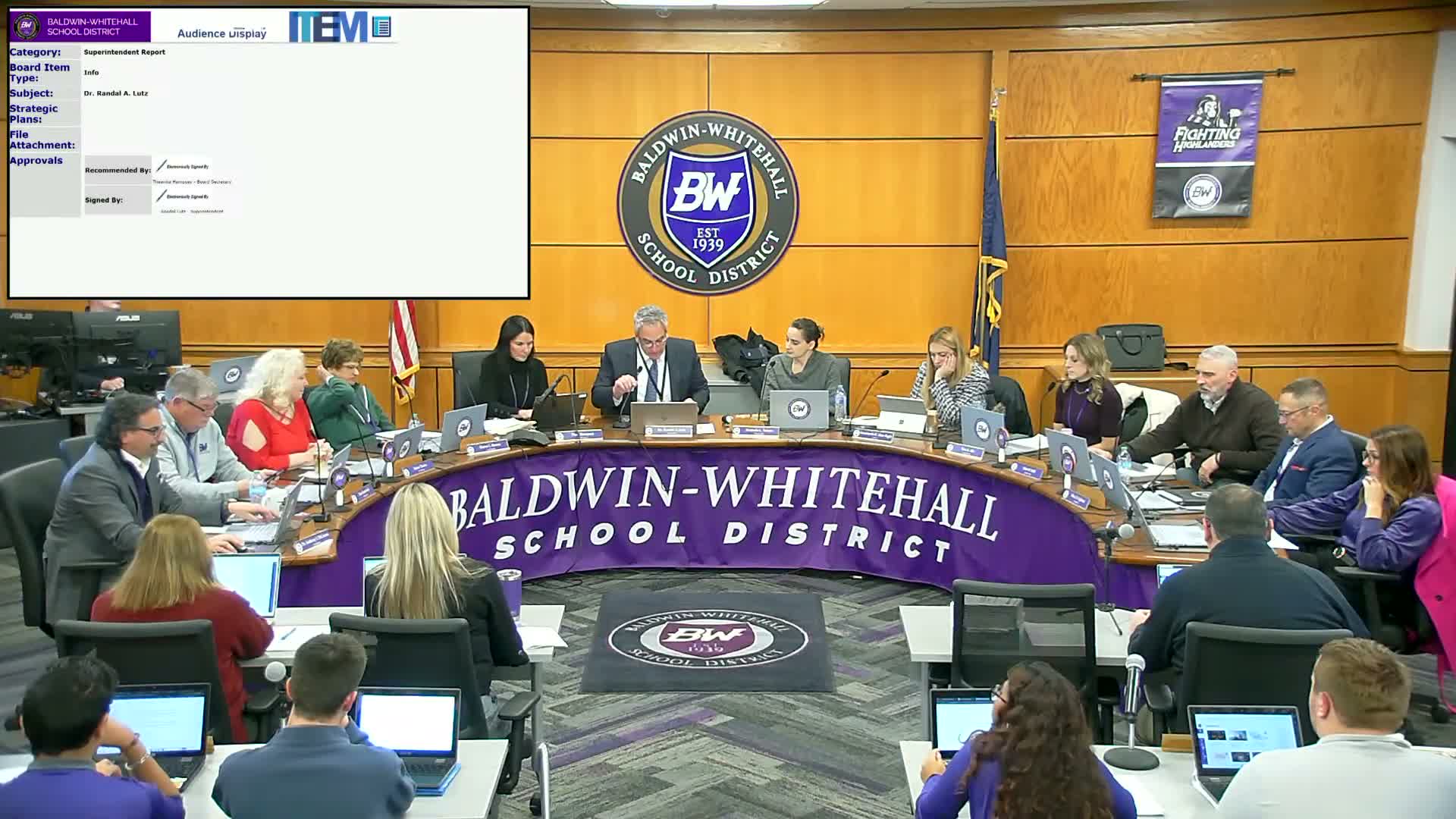
Summary
Superintendent Hector Lutz reviewed recent state school-code changes that affect admissions payment options, certification spans, cyber-school funding and attendance verification, mandatory firearm-incident notifications and phased literacy and FAFSA-related requirements. District staff said some changes will require new administrative regulations.
Superintendent Hector Lutz told the Baldwin-Whitehall board that a batch of state school-code changes tied to the late state budget will require procedural and policy updates at the district level.
Lutz said the changes include a requirement that public and nonpublic schools offering admission fees must maintain a cash-payment option and that certification spans for teachers were adjusted to simplify hiring in certain grade levels. He described measures affecting cyber-charter funding and reporting that could reduce payments for transportation and require cyber providers to perform weekly wellness checks with students — a change Lutz said will drive new compliance and reporting duties for districts.
On safety reporting, the superintendent noted a new rule requiring school districts, charters and staff to notify parents, guardians and employees within 24 hours of an incident involving a weapon on school property; he said he expects to revise administrative regulations to align district practice with the new timelines. Lutz also addressed residency-verification tightening effective Jan. 11 and a multi‑phase plan that ultimately will require graduating seniors (class of 2027 onward) to submit FAFSA or an opt-out form before graduation, while clarifying schools cannot withhold diplomas for failure to file.
"We know that the state budget finally, about 4 months late, came through," Lutz said, adding the changes included "some pretty hefty" school-code revisions. On cyber schools, he said the district anticipated some savings but that earlier caps did not fully materialize; he added that new restrictions on charter transportation claims could produce modest savings for the district. On parent notification requirements, Lutz said: "That's something we'll have to tighten up within our AR system."
The superintendent recommended administrative teams draft updated regulations, especially around attendance, wellness-check requirements for cyber providers, pupil residency disputes and structured literacy interventions planned across coming years.