
Texas Supreme Court hears dispute over H‑E‑B liability for grocery‑store slip
Get AI-powered insights, summaries, and transcripts
Subscribe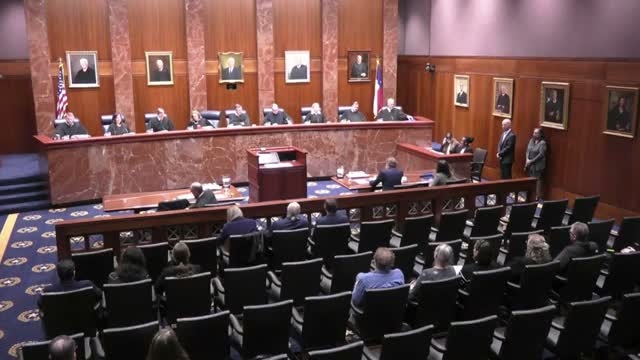
Summary
The Supreme Court of Texas heard argument in H‑E‑B v. Peterson over whether prior roof leaks and a store’s inspection practices gave H‑E‑B constructive notice of a hazardous puddle that caused a customer’s fall. Counsel disputed the record, timing and whether a vicinity rule should apply.
The Supreme Court of Texas heard argument in H‑E‑B v. Peterson on whether a grocery store can be held liable under a constructive‑notice theory for a customer’s fall on water inside the store.
Petitioners’ counsel, identified in the record as “Mister Jefferson,” said the record lacks evidence “actual or constructive” that H‑E‑B knew about a hazardous condition in the toy aisle and stressed there is no direct link between prior leaks and the aisle where the fall occurred. Respondent counsel, identified as “Mister Sloan,” pointed to incident reports, surveillance video and repair records to argue a jury could infer constructive notice.
Why it matters: The court’s decision could clarify how closely prior leaks must be connected to a specific hazardous spot before a premises owner can be held liable. Justices questioned whether adopting a broad vicinity or radius rule would impose unworkable burdens on large retail stores and whether the case’s facts support a wide legal pronouncement.
The record and disputed facts
Counsel described the store as roughly 60,000 square feet with refrigeration units clustered away from the toy aisle and testified that subcontractors were performing remodeling work near refrigeration units about 40 feet from the toy section. The transcript records that counsel for the petitioner emphasized multiple prior inspection and repair entries in the record but said none showed a leak above the toy aisle where the fall occurred.
Respondent pointed to a bench book of documents, photographs (including one dated January 2016), and an H‑E‑B incident report the night of the fall that attributes the water to rain. Respondent argued the combination of the manager’s report that water was “dripping from the ceiling,” the surveillance evidence, and repeated repair records could support a jury finding of constructive notice.
Timing and causation were central themes. Counsel debated whether the puddle could have formed in seconds or over hours. Respondent invoked an inference that rain had stopped about two hours before the accident; petitioner countered there is no record evidence showing how long the substance was on the floor or a direct connection between prior leaks and the toy aisle.
Precedent and standards
The bench and counsel discussed Rodriguez and other appellate authorities (the transcript references cases including McCarty and Fifth Circuit decisions) as guides to when circumstantial evidence permits a jury to infer constructive notice. Petitioners urged that juries require a factual connection between prior leaks and the specific hazard rather than speculation. Several justices expressed concern about imposing a rule that would require constant or near‑constant surveillance in large stores.
Quotes from argument
Petitioner’s counsel: “This is a case in which there is no evidence, actual or constructive, that HEB had notice of a premise condition that caused Peterson’s [injury].”
Respondent’s counsel described the incident report and manager testimony that water was seen dripping from the ceiling and argued that evidence, combined with repair records and surveillance, can be put before a jury.
What the record does and does not show
What is in the record: a bench book with numerous repair entries and photographs; surveillance video excerpts (bench discussion notes a timestamp around 09:13); an H‑E‑B incident report referencing rain as the source of the substance; testimony by store personnel about buckets/trash cans used during the rain; and references to roughly 170 recorded leak entries in the store’s records.
What the record does not specify: exact dimensions for the toy aisle, an express time stamp establishing how long the puddle had been on the floor prior to the fall, or a conclusive link tying prior leak reports directly to the precise location of the hazard.
Next steps
Counsel concluded argument and the case was submitted to the court; the transcript records the court taking a brief recess. The Supreme Court will decide whether the trial‑court record, viewed in the light most favorable to the nonmoving party, permits a jury to infer constructive notice or whether judgment should be entered for H‑E‑B as a matter of law.