
Attorney briefs Contoocook Valley board on open enrollment law, steps to limit inflow and outflow
Get AI-powered insights, summaries, and transcripts
Subscribe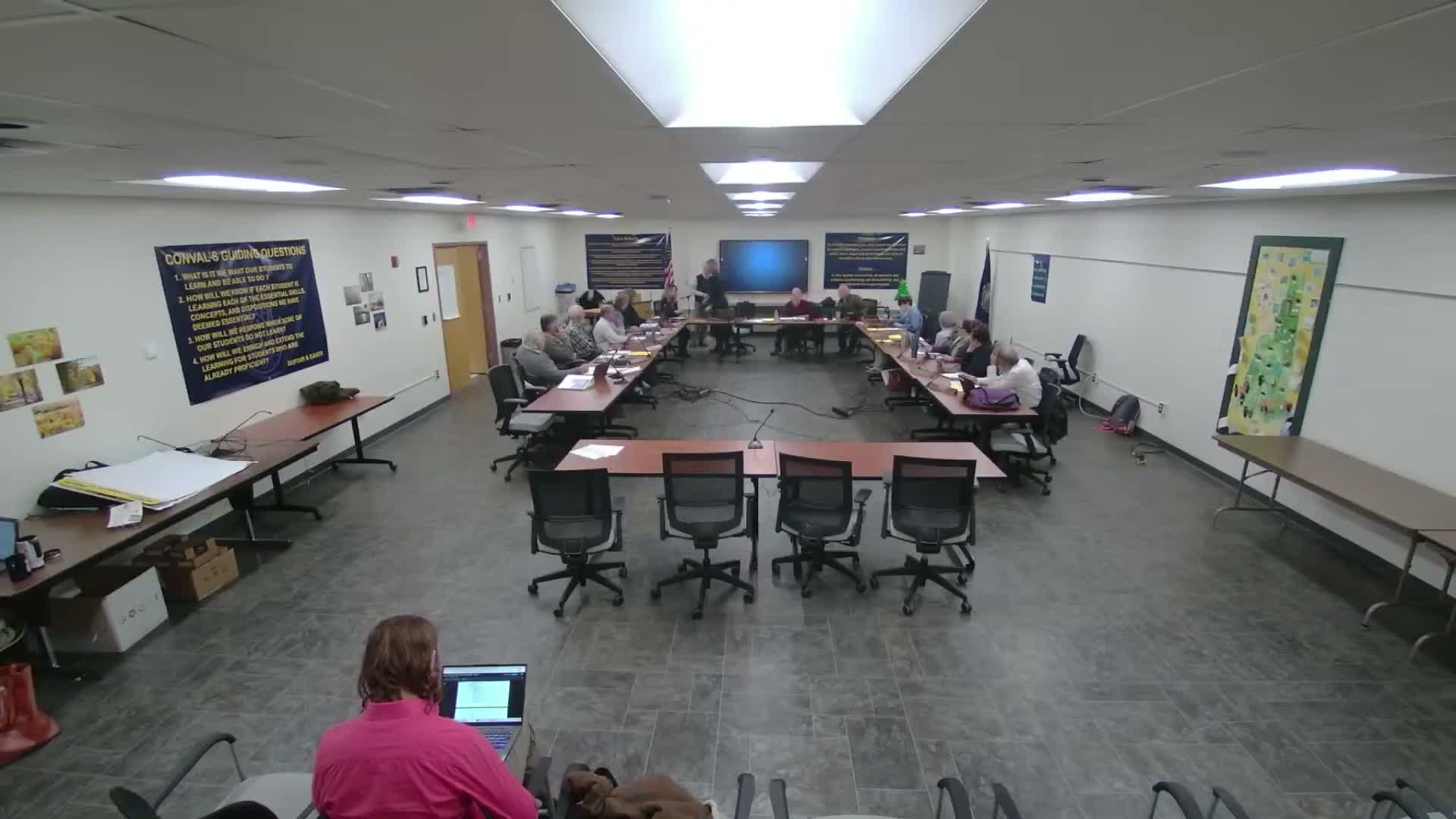
Summary
Attorney Dean Eckert told the Contoocook Valley School District board that adopting an open-enrollment designation raises complex fiscal, special-education and admission-process questions—most immediately, districts must study capacity, set inflow/outflow limits, and prepare a warrant article and public hearing if they proceed.
Dean Eckert, an attorney with the firm Wadley, Starr & Peters, told the Contoocook Valley School District board on Dec. 3 that open enrollment is a rapidly evolving area of New Hampshire law and cautioned the district to study fiscal and operational effects before acting.
"Open enrollment is a hot topic right now," Eckert said, and he noted the statutory definition appears in RSA 194-d. He outlined multiple existing mechanisms for nonresident attendance—best-interest reassignment, manifest educational hardship, tuition and area agreements, education freedom accounts (EFAs) and CTE access—and explained how open enrollment differs from, and can displace, those approaches.
Eckert emphasized financial consequences. Under current law, a district that receives nonresident students sets nonresident tuition but surrounding districts that send students may be required to pay "80% of their average per-pupil cost," he said. He warned that because the statute uses a single average per-pupil figure (not separate elementary/middle/high averages), neighboring districts could face varying and sometimes adverse fiscal outcomes.
The attorney also reviewed operational choices the district would face if it placed an open-enrollment article on the warrant: the board can limit open enrollment by school or program, adopt capacity and inflow limits (the statute allows 0–100% limits), set admission criteria tied to district academic goals, and create admission processes. Eckert noted an open-enrollment designation becomes effective on July 1 following adoption and recommended holding a public hearing at least 15 days prior to a deliberative session to educate voters.
Eckert described special-education implications: when a pupil attends another district under open enrollment, the sending district generally remains financially responsible for special-education services, and open-enrollment schools retain duties under Section 504 and IDEA to accommodate students with disabilities.
Board members asked about geographic scope, capacity adjustments and whether statewide changes would render local limits meaningless. Eckert recommended a phased study of "potential inflow and potential outflow," capacity limits set annually by citizens' votes if needed, and careful fiscal modeling before placing any article on the warrant.
The presentation cited the Pittsfield court decision as changing the unilateral options available to districts and noted pending legislative proposals that could make every district an open-enrollment district; Eckert advised monitoring state action before taking irreversible local steps.
The board did not vote on any open-enrollment action at the meeting; Eckert framed his talk as an informational legal briefing and offered to recess to nonpublic session should the board seek specific legal advice.