Get Full Government Meeting Transcripts, Videos, & Alerts Forever!
Get email alerts on the Rules And Regs topic
No spam. Unsubscribe anytime.
Consultants outline road, sidewalk, planting and lighting proposals in Lakeville rules-and-regs review
Summary
Consultants from Serpyn updated the Lakeville Planning Board on proposed rules-and-regulations changes covering public vs. private roads, sidewalk requirements with hardship waivers, curb radii by use case, planting standards, tree replacement timing, and dark‑sky‑compliant lighting. The board asked for DPW coordination and visuals for next steps.
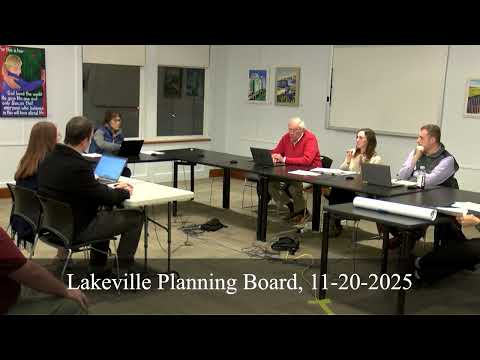
Taylor Perez, a consultant leading a rules-and-regulations review for the Town of Lakeville, told the Planning Board on Nov. 20 that his team would work with town counsel and staff to update standards governing roads, sidewalks, plantings and lighting.
Perez introduced colleagues Robert Froll, a landscape architect, and Sean Hilton, who is advising on transportation standards, and said the firm is preparing a fee schedule benchmarked to neighboring communities and will coordinate with the town’s environmental and DPW staff to incorporate stormwater and acceptance requirements. “We just wanted to give you folks an update on what’s going on with the, the rules and regulations review,” Perez said.
Why it matters: The board is seeking clearer, enforceable standards so that subdivisions built for future town acceptance meet DPW and fire-department needs; the changes aim to prevent the town from inheriting roads, drainage or planting obligations without documented inspections and peer review.
Key proposals and board direction
- Public vs. private roads: Consultants asked what make-or-break items would cause the town to accept a road. Board members said DPW peer-review at every step and clear record-keeping before acceptance are essential. The board asked the consultants to coordinate with the DPW director to produce a checklist of minimum items for town acceptance.
- Sidewalks and waivers: Perez presented a proposal to require sidewalks for subdivisions but allow a hardship waiver process. Board members favored requiring sidewalks on both sides for roads intended for town acceptance while permitting a waiver of up to one sidewalk on private roads with demonstrated hardship.
- Curb-cut radii and use cases: Consultants recommended different minimum curb-cut widths by use case (for example, tighter 10-foot cuts in neighborhood settings; 30-foot cuts for commercial driveways). The board preferred a case-by-case approach but asked for diagrams and ranges to guide decisions.
- Plantings and street trees: Froll recommended a list of native, deer‑resistant species and visual examples for street-tree and screening options. The board requested alternatives to street trees where utilities or roadway clearance create conflicts.
- Tree replacement and maintenance: Members raised a prior local example where screening trees died and were not replaced. The consultants recommended an establishment period for plantings; board members indicated five years as a reasonable maintenance/replacement window and discussed tying replacement obligations to HOA agreements or permit conditions.
- Lighting and dark-sky rules: Consultants proposed referencing the town’s existing dark-sky bylaw and light-trespass language rather than setting raw lumen numbers in the subdivision rules. The board agreed to mirror the town’s lighting regulations and check section references (the code includes a light‑trespass provision, noted in the packet).
Next steps and outreach
Perez said the team will: (1) coordinate with DPW to define acceptance checklists for roads, (2) provide sidewalk policies and hardship language for the board to consider, (3) prepare curb-radius diagrams and planting visual aids, (4) cross‑reference lighting requirements with the dark‑sky bylaw, and (5) circulate fee comparisons and a proposed timeline for review. The consultants anticipate returning in late January for further discussion.
The Planning Board did not take a formal vote on the substantive content but asked staff and consultants to produce a draft set of rules and visuals for future review and public outreach.