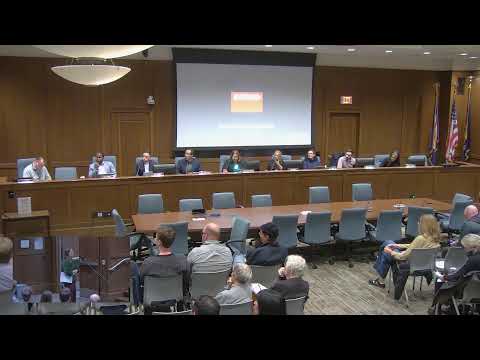
Lancaster City Council approves community benefits agreement for two data centers
Loading...
Summary
Lancaster City Council on Nov. 20 approved Resolution No. 79, accepting a community benefits agreement that secures environmental performance commitments, a $20 million contribution split across two community funds, and enforcement measures secured by letters of credit. The decision followed expert presentations and extended public comment both supporting and opposing the deal.
Lancaster City Council approved a community benefits agreement (Resolution No. 79) for two proposed data center campuses at 216 Greenfield Road and 1375 Harrisburg Pike at a special meeting on Nov. 20, 2025.
The agreement, negotiated between the city and site owners, commits the projects to a set of environmental and community measures before the council authorized city officials to implement it. Mayor Sarachi said the CBA "allowed us to negotiate environmental protections, operational standards, and community investments that go far beyond what zoning can require." Councilors recorded a series of votes after public comment and expert testimony; the transcript records Aye votes from Mann, Royo, Kleece, Craig and Hirsch and a Nay from Diaz; the motion carried.
The CBA’s environmental terms include a water-use cap, noise controls tied to existing ambient levels, and requirements for air-emissions controls. City Solicitor Barry Handwerger told council the agreement sets a "Maximum of 20,000 gallons per day per campus" for water use. Acoustic consultant Gabriel Weger (Burns & McDonnell) explained the CBA requires owners to measure existing ambient sound levels and hold project-generated noise at nearby "noise sensitive areas" to no more than the lowest one-hour equivalent ambient measurement recorded during daytime and nighttime monitoring. Al Yates of ARM Group, the city's air-permitting reviewer, said the state draft plan approval for Greenfield limits each emergency engine’s operation to "100 hours per year based on any consecutive 12-month period," and that the owners plan to use Tier 2 engines, ultra-low sulfur diesel and selective catalytic reduction with particulate filtration.
Financial commitments and governance were a central part of the agreement. The developers (identified in the resolution as project LLCs associated with the owner/developer) will contribute $20 million overall: $10 million to an economic development fund managed by the Lancaster County Community Foundation (with Lancaster EDC in a strategic role) and $10 million to a city-managed sustainable development and clean-energy fund. Staff described a phased payment schedule tied to each building’s construction financing and commencement of operations; an initial $250,000 planning tranche is included to allow early fund planning.
The CBA also includes incentives and disincentives tied to clean-energy performance. Handwerger said sites must demonstrate 100% clean energy to receive a final certificate of occupancy, or provide a 10-year power purchase agreement (PPA). If tenants present a 10-year PPA for less than 100% but above specified thresholds, they may make prescribed payments into the city’s sustainability fund (examples discussed included a $2.5 million payment tied to an 80–100% PPA band and $5 million for a 60–80% band; the Harrisburg Pike building’s payments were described as approximately double those amounts). Those payments are secured in part by letters of credit; staff said the letters of credit are the principal collateral and will be reduced as payments are made.
The CBA also requires multiple plans to be submitted and approved for each building — including noise mitigation, lighting (consistent with international dark-sky principles), landscaping and tree canopy, stormwater and thermal-heat mitigation, an emergency-management plan, an e-waste and decommissioning plan, and a local-hiring plan — and includes annual reporting requirements for energy use and sources.
On enforcement, the solicitor emphasized that the agreement creates remedies beyond simple monetary damages. "There is no adequate remedy at law," he said, adding that the city can ask a court for equitable relief, up to and including orders to stop operations if defaults are found. He described a notice-and-cure process in the agreement and explained how the letter of credit secures payments to the community funds.
Public comment was lengthy and split. Supporters — including local contractors, the Lancaster City Alliance and several economic-development representatives — emphasized job and investment opportunities and said the CBA provides enforceable protections. Other speakers criticized the pace of the negotiations and the limited period for public review, called the CBA "a community benefits agreement without the community," expressed health and environmental worries about diesel backup generators and long-term industrial use, and urged delay or rejection. One commenter said, "This is a community benefits agreement without the community," and another told council, "We can't eat money; we can't breathe money." Several residents asked for stronger independent monitoring, third-party audits, and a formal community oversight body to track compliance and spending of the funds.
Councilors asked detailed questions about fund governance, whether the funds could be used for affordable housing (staff said the funds are intended for economic development and sustainability projects tied to the project’s nexus), whether city staff or councilors had signed nondisclosure agreements (multiple councilors stated they had not), and the consequences of a no vote (solicitor: rejecting the CBA risks letting the projects proceed under existing permitted uses without the negotiated benefits).
The council vote recorded on the transcript lists Aye votes from Mann, Royo, Kleece, Craig and Hirsch and a Nay from Diaz. Following the vote, council moved to adjourn.
What happens next: the CBA requires multiple plan filings and approvals, PADP and operating-permit processes for air emissions remain in the state’s permitting pipeline, and payments and performance will be phased per building. The agreement, as explained in council chambers, ties continued site approvals, plan acceptance and final certificates of occupancy to the CBA’s commitments.
Speakers quoted in this article are drawn from the meeting record. Where details (for example, the PADP permit text or the exact letter-of-credit language) were not read in full at the meeting, the article reflects what council heard and what city staff and consultants said on the record.