
Troutdale budget committee warns rising fire and sheriff contracts will strain general fund
Get AI-powered insights, summaries, and transcripts
Subscribe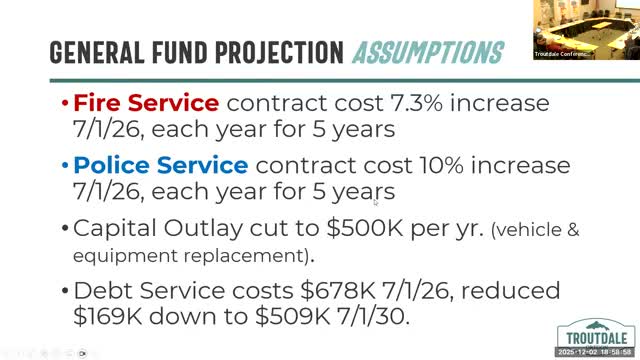
Summary
Committee heard staff say a new five-year fire contract with Gresham (7.3% annual increase) and a three‑year sheriff/police IGA (10% annual increases in the IGA years) are driving projected deficits and will force choices on levies, a fire district or higher utility fees.
Chair opened the November work session by flagging public-safety costs and turning the meeting over to staff for a technical briefing. City staff told the Troutdale Budget Committee that contracted increases for Gresham Fire and the Multnomah County Sheriff are the primary drivers of a multi‑year budget gap.
Mister Newton, who led the financial presentation, said the new five‑year fire agreement carries a 7.3% annual increase and the sheriff’s three‑year intergovernmental agreement carries steep increases in its initial years. "The fire service contract 7.3% annual increase — that’s what’s in the contract," he said, and described the police IGA as containing 10% increases for each of the first three years.
Why it matters: staff projected those contracted cost increases will outpace expected general fund revenue growth and erode the city’s fund balance over the forecast horizon. Chair noted the committee has seen a roughly $4.4 million increase in combined police and fire costs over the past five years and "we're gonna see another increase coming up of another million 4," underscoring the fiscal pressure.
Committee members pressed staff for numbers and options. Members discussed the mechanics and political tradeoffs of several responses: keep the current $15/month police-and-fire fee (already part of utility bills), place a temporary local option levy before voters, pursue a five‑year public‑safety levy, or form/join a fire district. Staff said the five‑year Gresham deal buys time for a four‑city task force to analyze longer‑term arrangements and that the contract includes an opt‑out clause in year one.
Several members urged exploring locally controlled options. "We could do a five‑year levy," one councilor said, and others asked staff to identify how much revenue might be raised by earmarking new economic development (for example, an anticipated battery‑site increment) for public safety rather than the general fund.
Next steps: staff said they will present detailed year‑by‑year contract numbers in the upcoming slide deck and produce balanced budget scenarios for the committee’s April deliberations, including levy and district options.
Ending: The committee agreed the public‑safety contracts are the most urgent budget pressure and directed staff to return with clearer, line‑by‑line options to avoid a projected rapid decline in the general‑fund cushion.