
Developer withdraws Barber Farm annexation and rezoning after widespread neighborhood opposition
Get AI-powered insights, summaries, and transcripts
Subscribe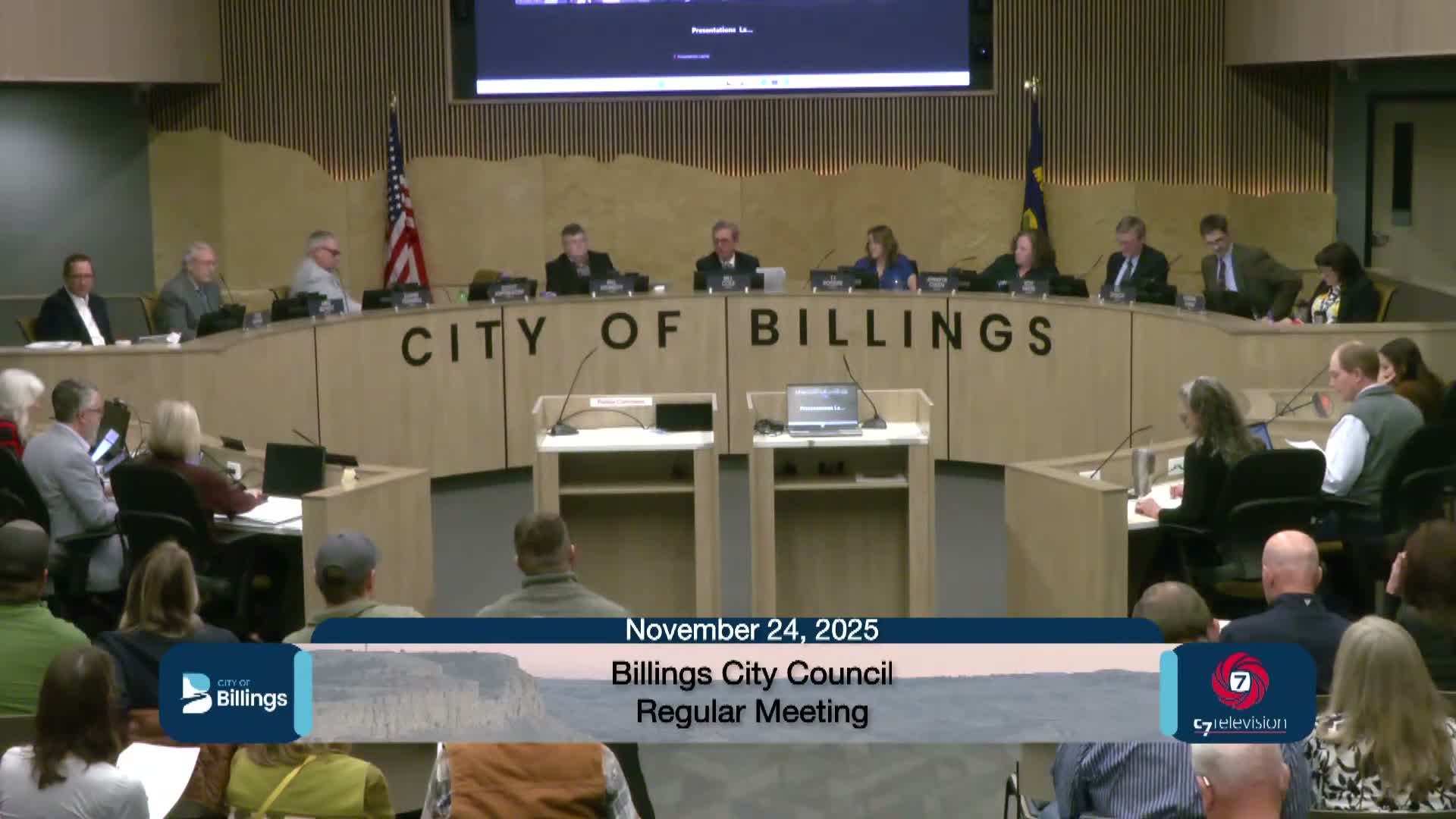
Summary
After three hours of public comment highlighting traffic, school capacity, aquifer and compatibility concerns, the developer of the Barber Farm proposal asked to withdraw the annexation and zone-change application; the council unanimously accepted the withdrawal so the plan can be retooled.
Taylor Kasparick, the developer's agent for the Barber Farm proposal, asked the Billings City Council to withdraw the package of annexation and rezoning requests for the 55.46-acre Barber Farm subdivision so the developer could meet again with neighbors and rework the proposal. The council voted unanimously to accept the request, ending the joint public hearing without adoption of annexation 25-0-6 or zone change 10-74.
Supporters of the withdrawal said it would give the developer an opportunity to address concerns raised repeatedly at the hearing. "We would move forward with withdraw or requesting to withdraw the application tonight and potentially retool the application and come back before city council," Kasparick said when asked by councilmembers whether the applicant would step back. The developer had argued the proposal aligned with the city's growth policy and that the primary residential product planned was duplex-style housing rather than large, high-rise apartment buildings.
Residents from Cloverleaf Meadows, Sundance, Twin Pines and other nearby subdivisions spoke in near-uniform opposition during the hearing. Kelsey Ryder, speaking for neighborhood mothers, said the proposal "does not comply with Billings zone change criteria" and warned of increased traffic and pressure on nearby schools if 350 units are built. Susan Sullivan told the council that the meeting itself had created "market uncertainty" that could depress home valuations; she noted her property taxes had increased sharply and warned of economic harm to adjacent neighborhoods. Multiple speakers raised safety and traffic concerns along Central Avenue and Broadwater, questioned whether planned road segments are funded in the city's five-year CIP, and asked where additional students would attend school.
City staff and the developer responded to questions about phasing and infrastructure. Planning staff explained the application is a two-phase annexation: council would annex and zone the phase 1 area now, and phase 2 would be annexed later (staff said phase 2 in the draft documents could become effective as late as Dec. 31, 2031, unless the developer requested it earlier). City engineering staff said many of the long-range road connections (44th, 46th, Broadwater to Shiloh) are not currently funded and that some future improvements would depend on other projects or capital programming; the traffic impact study (TIS) prepared for the subdivision is available through city staff.
Opponents urged the council to require a stronger transition between the proposed higher-density portions of the project and the adjacent low-density neighborhoods, to ensure park dedications or contributions, and to resolve questions about aquifer recharge and septic/nitrate impacts before any rezoning. "It would be a nice park," one resident said; another asked whether casinos or nightclubs could later be located along the CMU frontage. The developer said the CMU areas are intended for neighborhood-serving commercial uses and that zoning code stop-gaps (setbacks, special review) exist before more intensive commercial uses could locate there.
Council members debated whether to refer the application back to the zoning commission (a process that requires a 60% majority and re-noticing) or to accept a voluntary withdrawal. Given the breadth of public concern and new information raised at the hearing, Kasparick's office requested withdrawal to redesign the proposal and to meet again with neighbors. Councilmember Abouya moved to accept the withdrawal and Councilmember Kennedy seconded; the motion passed unanimously. The withdrawal leaves open the developer's right to resubmit a revised application in the future.