Wyoming Retirement System requests TRP and staffing flexibility as turnover rises
Loading...
Summary
WRS Executive Director David Swindell told the committee WRS manages roughly $12–13 billion, is seeking TRP funds for RAIN programming and cybersecurity, and urged legislative flexibility on analyst promotions to address high turnover and key‑person risk.
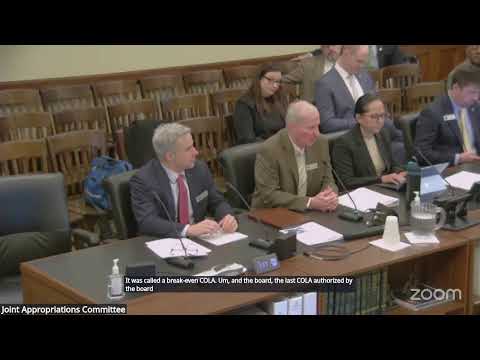
David Swindell, executive director of the Wyoming Retirement System, presented the system’s budget exception requests and staffing concerns to the Joint Appropriations Committee.
Swindell said WRS employs 53 full‑time staff, administers eight plans, and manages about $12–13 billion in assets. He reported roughly 36,000 pensioners and 41,000 active employees and said the system paid approximately $829 million in benefits last year, with roughly $647 million paid into in‑state economies.
Why this matters: WRS argued continued investment in technology, cybersecurity and staffing is necessary to protect member accounts, meet benefit payments and reduce key‑person risk that can arise when analyst positions are vacant. Swindell described a recent period of elevated turnover — 11 recruitments in the last year across 50 positions — and said that creates operational risk for investment accounting and oversight.
Swindell outlined several exception requests. The technology package includes a $1,459,000 programming contract to retain about 1.5 programmers for the RAIN (Retirement Administration Information Network) system, $300,000 for an independent cybersecurity consultant (about $150,000 per year in the initial contract), and $100,000 to replace legacy investment‑contract tracking software. Swindell said RAIN was contracted circa 2010 and launched in 2014, and that the current TRP ask is primarily for a two‑year development/maintenance effort.
The presentation also covered personnel and governance issues. Swindell requested three reclassifications (including recognition for a chief benefit officer and an investment officer promotion) and sought limited legislative authority to allow promotion flexibility within junior investment grades to avoid losing analysts to the private market. He recounted that an auditor in 2018 identified an investment‑accounting deficiency, which prompted a restoration of that function and underlined the risks of operating with too few analysts.
Committee members asked whether a governor’s B‑11 one‑time budget authority could solve promotion timing; staff said B‑11 is temporary and can create retention uncertainty if not made permanent. Members also discussed a governor proposal to fund investment operations with a basis‑point allocation of assets; Swindell said the governor declined that approach for this cycle.
Swindell addressed cost‑of‑living adjustments (COLAs), noting a 2012 statutory change that restricts the board from recommending a COLA until the plan reaches full funding; he said the public‑employee fund measured about 80% at the last actuarial measurement and that the last board‑authorized COLA was 1.03% in 2008.
The committee posed follow‑up questions on RAIN’s lifecycle, cybersecurity coordination with ETS, and the case for three investment analysts as the minimum safe staffing level. No formal vote was recorded; the WRS presentation concluded and the committee recessed.
Sources and attributions: figures and quotes above come from David Swindell and the WRS staff presentation in committee testimony.