Get Full Government Meeting Transcripts, Videos, & Alerts Forever!
Get email alerts on the Comprehensive Plan topic
No spam. Unsubscribe anytime.
East Lansing planning commission reviews comprehensive plan update with social equity, housing and resilience focus
Summary
Planning staff presented a deep dive on the 2025 comprehensive plan update on Nov. 19, emphasizing social equity as a guiding lens and recommending zoning and implementation steps to expand housing choices, improve public health outcomes and increase climate resilience.
Planning staff presented a slide-led review of East Lansing’s 2025 comprehensive plan update at the Nov. 19 Planning Commission meeting, telling commissioners that social equity emerged from public engagement as the plan’s top priority.
Landon Bartley, planning staff, said early outreach at Winterfest 2023 and subsequent committee work prompted the commission to frame housing, public health and climate resilience through an equity lens. “Social equity was the number 1 priority of folks,” Bartley said, adding that the plan emphasizes implementation actions and partnerships with the city’s DEI office and community groups to reach marginalized residents.
The presentation summarized extensive engagement: a coordinating committee that met through 2024–25, student outreach with almost 500 student interactions and 13 on-campus workshops, and 160 online survey responses. Bartley said student input aligned with broader community themes such as affordable housing and healthier food access.
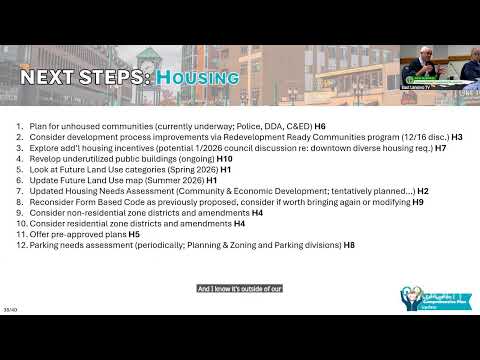
On housing, Bartley said the plan prioritizes expanding housing choices by encouraging “missing-middle” types—duplexes, triplexes, fourplexes, cottage courts and accessory dwelling units—while limiting greenfield development in environmentally sensitive northern areas. He described implementation tools the city is considering, including: updating the future land use map in spring, zoning ordinance changes to increase housing supply and diversity, preapproved small-unit plans to speed construction of gentle density, and incentives for attainable housing and aging-in-place measures.
Commissioners pressed staff on data and assumptions. One commissioner questioned a projection of an additional roughly 8,000 residents by 2050, arguing population trends flattened in past decades. Bartley said the projection reflects post‑1990 growth trends and depends on how much new housing is approved and built. “If new housing units weren’t constructed, it may not necessarily be because there wasn’t a market. It may be because they weren’t approved,” he said.
The presentation also addressed public health and climate resilience. Staff proposed actions to improve walkability, tree canopy and intersection safety, and recommended accessibility audits and improved pedestrian crossings and bike protection. On climate resilience, the plan recommends prioritizing redevelopment along transit corridors, expanding green infrastructure and pursuing stormwater and wet-weather resilience measures led by the Department of Public Works.
Bartley said short-term work is already underway—parking needs, wet-weather resilience planning and green code committee recommendations—and urged the commission to help translate the plan into implementable zoning and administrative steps. Commissioners suggested practical next steps: using the plan in decision-making on development proposals, exploring ADU policy updates as a near-term change, and creating a scorecard or regular agenda item to track implementation progress.
Bartley also announced a focused East Village subplan will begin next semester and invited commissioners to participate. He said staff will return to the commission with the Sheetz traffic study and continue the conversation on zoning adjustments in early 2026.
The commission did not take formal votes on zoning changes or plan amendments at the meeting; the session served as a detailed briefing and an opportunity to prioritize near-term implementation work.