
State lands director asks Appropriations to approve wildfire funding, mapping contracts and trust grants
Get AI-powered insights, summaries, and transcripts
Subscribe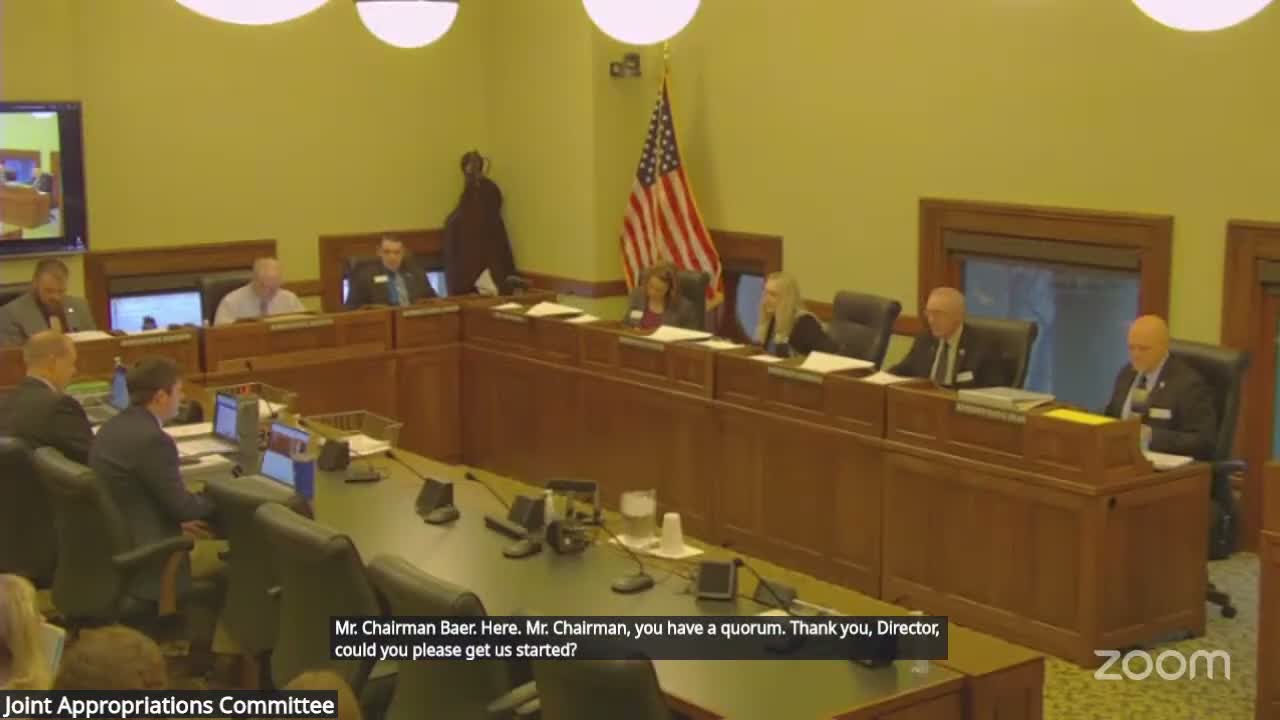
Summary
Director Stacia Berry told the Joint Appropriations Committee that the Office of State Lands and Investments manages 3.4 million surface acres and is seeking exception requests including $20 million for emergency fire suppression, two Esri GIS contract requests, and $340,907 for trust‑land preservation projects.
The Joint Appropriations Committee heard from Stacia Berry, director of the Office of State Lands and Investments, about the agency’s budget priorities and 16 exception requests tied to land management, mapping and wildfire costs. Berry told the committee the office administers trust lands that support K–12 beneficiaries and oversees roughly 3,400,000 surface acres and about 3,900,000 subsurface acres.
Berry said minerals produced about $139.6 million in fiscal 2025 and surface leasing and sales about $122 million, together generating more than $262 million for trust beneficiaries. She outlined several grant and loan programs the agency administers, including a $24 million mineral royalty grants program and drinking‑water and clean‑water state revolving funds that provide low‑interest loans and principal forgiveness to communities.
Why it matters: committee members flagged wildfire costs and mapping contracts as near‑term pressures. The governor recommends a mix of one‑time and ongoing funding; the committee must balance those requests against statewide fiscal tradeoffs and program constraints.
Berry presented a series of exception and technology requests. Two Esri‑related items were described as IT and GIS needs for enterprise mapping: an ongoing contract estimate of $468,419 for software licensing and a one‑time $29,500 parcel fabric update to automate survey updates. Jeff Klines, director of ETS, told lawmakers the state is moving to a named‑user Esri licensing model and that an RFP and enterprise negotiation may produce additional savings.
Wildfire and staffing requests dominated committee discussion. Berry described a governor’s recommendation of $20 million one‑time for the emergency fire suppression account and an accompanying extension of borrowing authority to $30 million from the LSRA to preserve liquidity through the next biennium. State Forester Forrester Norris and Director Hibbert said the request is meant to ensure the state can respond to a season similar in scale to 2024. Vice Chair Driscoll and other members questioned whether the state should instead place existing cash into a restricted account to earn interest for prevention rather than relying on borrowing authority; Hibbert and Berry emphasized the need for liquidity and the flexibility that borrowing authority provides.
The agency also asked for staffing to address wildfire workload: a fire business assistant position to speed invoice processing ($184,596), two 12‑person wildland fire modules (about $2.0–2.3 million each) to increase boots on the ground and fuels‑mitigation capacity, and a public information officer ($195,530) to coordinate communications during incidents. Norris said billing and federal reimbursement complexity have tripled workloads in two years and that additional accounting capacity and module staff are needed to avoid audit risk and payment delays.
Other items on the table included a $340,907 trust preservation and enhancement account request for cleanup and thinning projects across state‑managed parcels, a $1 million transfer from the transportation enterprise interest account to WYDOT for Wyoming Air Services, and a TRP package to support equipment and technology for the proposed fire staffing. On mineral leasing, Berry explained surface impact payments are negotiated with grazing lessees and typically split 80/20 (80% to trust beneficiaries, 20% to grazing lessee); oil and gas auction royalties are set at two different rates depending on auction versus over‑the‑counter processes.
What’s next: committee members asked staff for follow‑up details (account balances, historical expenditures and TRP negotiation outcomes) before floor consideration. Berry and staff committed to deliver more granular spending histories and to keep appropriators informed as negotiations and RFPs proceed.