Guam Committee of the Whole debates $8.1M pharmaceutical-fund payment to Guam Memorial Hospital amid accounting dispute
Loading...
Summary
Legislators debated Bill 186-38 COR, which would appropriate $8.1 million claimed owed to Guam Memorial Hospital from the pharmaceutical fund. Hospital officials say audited figures show arrears; DOA and BBMR say accounting bases differ and no unobligated funds are currently available. Senators debated amending budget language as an alternative.
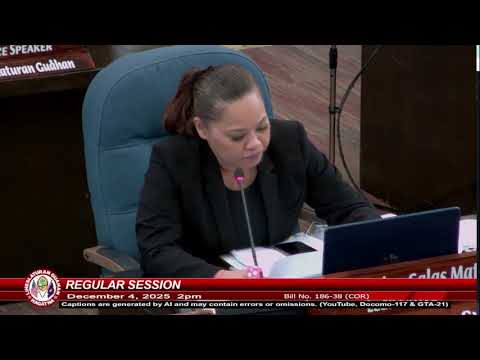
Senators in the Committee of the Whole considered Bill 186-38 COR on Dec. 4, a measure the sponsor described as "an act to appropriate the unallotted balance of the pharmaceutical fund to the Guam Memorial Hospital Authority." Senator Sabrina Salas Montanani, the bill's sponsor, told colleagues the bill would not create new spending but would "compel the release of already realized revenue" that she said GMH is owed, citing audited differences that total about $8.1 million.
GMH officials told the committee the calculation is straightforward. "We're always short," GMH said, explaining that their arithmetic multiplies the statutory 6.19% by audited Business Privilege Tax (BPT) receipts and then compares that amount with what the hospital actually received. GMH CFO Yuka Hichenova said the proposed appropriation would cover a roughly $3 million operating shortfall projected in the FY26 budget and seed a $5 million supplies reserve to avoid running out of critical medications.
Department of Administration Director Edward Byrne and Bureau of Budget and Management Research Director Lester Carlson disputed the premise that unappropriated funds are available today. Byrne said the government followed the budget law and that audited "earned" revenues differ from the CRER collections report used for cash disbursements: "The audit numbers for revenues are revenues earned, not revenues received." Carlson and other budget staff explained that prior appropriations and the mechanics of the fiscal-year budget can produce different numbers on paper and in cash, and that the unassigned fund balance is currently obligated.
The public auditor and other panelists warned that accounting bases differ. Public Auditor Benjamin Cruz said funds and accounts have been commingled in ways that make direct comparisons difficult, and BBMR advised reconciling audited (accrual) and collected (cash) numbers before final action. Several senators urged DOA, BBMR and GMH to meet and reconcile the spreadsheets so the exact amount owed can be agreed by all parties.
Some senators proposed a faster, alternative path to get money to GMH: amend the recently passed FY26 budget appropriation that earmarks $20 million in anticipated excess revenues so that a share of that line would be released now if collections materialize. BBMR said revising the budget language to draw from realized FY26 excess collections could deliver money sooner than the method in the bill, which references fund balance the DOA says is presently fully obligated.
Procedural votes punctuated the hearing. The chair ruled a proposed amendment requiring quarterly reporting from DOA and BBMR non-germane; a motion to overrule the chair failed. A motion to refer the bill back to committee also failed after objections. Senator Salas Montanani closed by moving to place the bill on the third-reading file and to add a cosponsor; the cosponsor motion passed with no objection before the committee recessed.
The committee record shows the central factual disputes remain unresolved in the hearing: GMH and the Office of Finance and Budget provided different sets of audited and budgetary calculations, while DOA and BBMR said available unobligated funds are not currently present to satisfy an immediate cash transfer. The next procedural steps include whether the bill is placed on third reading and whether sponsor or other members pursue an amendment to draw on FY26 excess collections so GMH can receive funds sooner.