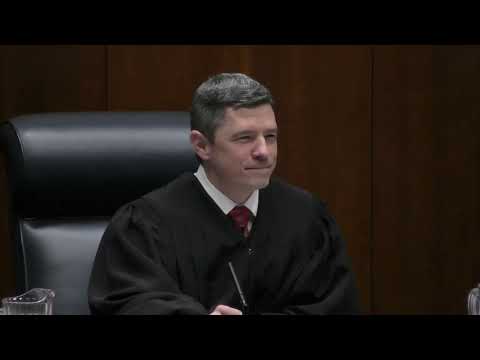
Supreme Court of Texas hears dispute over whether continued lease talks can support a fraud claim
Loading...
Summary
The court heard arguments in Maya Walnut v. Lee about whether statements that lease negotiations will continue can be treated as actionable misrepresentations and whether the 'red flag' doctrine bars a fraud claim where a tenant might have discovered contrary facts.
The Supreme Court of Texas heard argument in Maya Walnut v. Lee, a commercial dispute over whether continued lease negotiations can give rise to a fraud claim and how the court’s "red flag" doctrine governs justifiable reliance.
Mister McCarthy, counsel for petitioner Maya Walnut, told the Court that Walnut Creek’s communications — including a nondisclosure agreement and repeated assurances that final terms would be discussed later — induced his client to continue negotiating rather than secure alternate premises. "[T]he jury saw specific representations," McCarthy argued, asserting the landlord’s conduct amounted to a scheme that deprived Maya of her business opportunity.
Miss Johnson, counsel for the respondents, urged the Court to reject a new fraud theory based on continued negotiations. She said the petition asks the Court to infer an implied fraud "by continued negotiations" where there is "absolutely no evidence of affirmative misrepresentations," and noted that 15 months remained on the lease, allowing commercial parties time to protect themselves contractually.
The justices pressed both sides on two central issues: (1) whether statements about future negotiations are inherently unverifiable and therefore constitute "red flags" that defeat justifiable reliance, and (2) what minimal inquiry a reasonably prudent commercial tenant would be required to make. One justice framed the question succinctly: how many red flags are enough to bar a jury from finding justifiable reliance? Counsel for petitioner responded that the number of red flags is not a strict numerical test and that the question should be for the jury where the record permits.
The parties also disputed what the trial record actually shows about market offers and incentives. The bench and counsel discussed competing square‑foot figures — petitioner's counsel emphasized contested testimony about an offer at $7.25 per square foot, while other record evidence showed El Rancho ultimately paying $11.25 per square foot. Respondent’s counsel said the record contains no evidence of a conspiracy or an anti‑competitive "bounty," noting that the evidence instead reflected an old, favorable lease and ordinary commercial bargaining.
Both sides addressed the nondisclosure agreement (NDA). Counsel for the respondents said the NDA did not prevent discovery of the existence of another lease and that the record is sparse regarding the NDA’s precise terms; petitioner’s counsel maintained the jury reasonably heard testimony that the NDA constrained communications about lease terms.
Several justices returned the argument to precedent. Counsel for respondent relied on cases holding that inherently unverifiable promises about future conduct are red flags, while petitioner cited the jury charge and disputed that the record lacks evidence supporting a fraud theory. Counsel for respondent warned that adopting an implied‑fraud‑by‑continued‑negotiations rule would represent a "massive change in Texas" law.
The argument concluded with petitioner’s brief rebuttal urging the Court to read specific testimony, including references to noncompete and indemnity provisions and square‑foot price differences, which counsel said supported the jury’s assessment of inducement. The Court did not announce a decision from the bench.
The Supreme Court will decide whether continued negotiations, standing alone or combined with other record evidence, can support an actionable misrepresentation when measured against Texas’s red‑flag precedents and the reasonableness of a commercial tenant’s inquiry.