Get Full Government Meeting Transcripts, Videos, & Alerts Forever!
Get email alerts on the I90 Climate Resiliency topic
No spam. Unsubscribe anytime.
Rapid City staff outline I‑90 Corridor climate resilience plan backed by $1 million EPA grant
Summary
Public Works sustainability manager LaSanne Zeller presented an I‑90 Corridor climate resiliency plan funded by a four‑year $1,000,000 EPA planning grant, highlighted a corridor greenhouse gas inventory (3.4 million metric tons CO2e) and recommended pursuing a mid‑range 31% emissions reduction scenario by 2050; council acknowledged the plan.
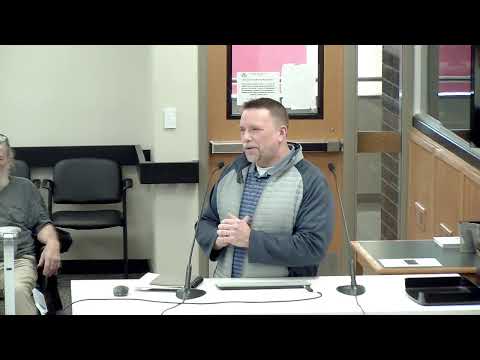
LaSanne Zeller, sustainability and stewardship program development manager in Rapid City’s Public Works Department, briefed the board on a four‑year, $1,000,000 EPA planning grant and the resulting I‑90 Corridor climate resiliency plan on Nov. 25.
"This was a $1,000,000 planning grant to develop plans for reducing climate pollution or greenhouse gas emissions in our region," Zeller told the board. She said the grant covers the Rapid City Metropolitan Statistical Area and that the project team expanded the greenhouse gas inventory to cover an I‑90 Corridor from Spearfish to Box Elder that includes Whitewood, Sturgis, Piedmont, Somerset, Box Elder and Ellsworth Air Force Base.
Zeller presented the corridor inventory: total greenhouse gas emissions of about "3,400,000 metric tons of carbon dioxide equivalent" and a per‑capita emission figure of roughly 23.4 for 2021. She said modeling produced three scenarios — a 10% reduction, a 31% reduction and a 58% reduction — and staff recommended focusing on the 31% scenario as ‘‘the most realistic, but also challenged just a little bit.’’ Under that scenario, per‑capita emissions would fall to about 9.3 by 2050, Zeller said.
Zeller emphasized public outreach during the planning process, saying a task force and community engagement produced strong support: "58% thought it was very important" and another 28% said it was "somewhat important," meaning roughly 86% of survey respondents favored addressing climate pollution. She described priority low‑carbon measures the plan identifies — from improved building efficiency, tree planting and renewable energy deployment to industrial process changes such as low‑carbon cement and expanded electric vehicle adoption — and noted the largest modeled savings came from low‑carbon concrete and from electrifying personal vehicles.
Zeller cautioned that some levers are beyond local control; for example, she noted the state Public Utilities Commission sets net‑metering policy in South Dakota, which affects the economics of rooftop solar. She outlined next steps: Rapid City will submit a draft to the EPA Dec. 1, hold corridor presentations (including a consultant webinar Dec. 11), and continue planning engagement through 2026 with a final deliverable due in 2027.
Councilmember Tamang thanked staff and asked whether the plan addressed state net‑metering policy; Zeller acknowledged that net‑metering is not in place in South Dakota and said it would require broader policy discussion beyond the city’s direct authority. After questions, the board voted to acknowledge the presentation.