Get Full Government Meeting Transcripts, Videos, & Alerts Forever!
Get email alerts on the Infrastructure Dock topic
No spam. Unsubscribe anytime.
Oregon City staff report dock can support original vessels; commission OKs $20,000 repairs and to explore expanding short "stop-and-go" commercial stops to ~90‑
Summary
Oregon City staff presented a KPFF structural assessment of John Storm Dock showing the facility can support its original 60‑ft design after roughly $20,000 in repairs; commissioners directed staff to pursue a middle‑ground (~84–90 ft) stop‑and‑go commercial scenario with the Oregon State Marine Board while noting potential repayment, environmental and navigation constraints.
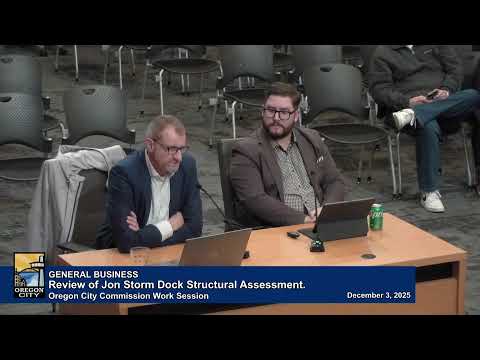
Oregon City staff told the City Commission on Dec. 3 that a consultant’s inspection found the John Storm Dock structurally sound for its original design vessel after modest repairs, and outlined what upgrades would be needed to accommodate larger commercial vessels.
Tom Kissinger, Parks and Recreation deputy director, summarized KPFF Consulting’s combined dive and above‑water inspection and said, “The estimated cost for that is about $20,000,” referring to repairs needed to restore the dock to its original 60‑foot, 40‑ton capacity. Staff said that work — replacing missing through rods, repairing damaged whalers and bull rails — is within the department’s routine maintenance budget.
The assessment evaluated two larger, existing vessels as real‑world test cases: the Portland Spirit (about 150 feet, 360 tons) and the Crystal Dolphin (roughly 84 feet, ~91 tons). KPFF modeled two operational modes: short‑term “stop‑and‑go” pick‑ups or drop‑offs and prolonged stays. For a Portland Spirit‑sized vessel in stop‑and‑go use, staff relayed KPFF’s finding that current piles could not safely absorb expected energy at low water and that upgrades — including Seaguard fenders, 10‑ton bollards and steel whalers — were estimated at approximately $470,000. Prolonged‑stay options raised wind‑speed design assumptions and larger mooring loads; alternative upgrade concepts presented were in the roughly $770,000 range and would reduce recreational docking space.
By contrast, staff said John Storm could accept a Crystal Dolphin‑sized vessel for brief stop‑and‑go operations without significant upgrades; but longer stays by that size would still require additional work. Kissinger emphasized that KPFF used existing vessel examples because the Oregon State Marine Board had rejected prior analysis that relied on a hypothetical vessel.
The presentation also flagged ancillary needs and costs: a separate dive report identified damage to the debris boom that protects the dock, with estimated repairs near $70,000 for which the city does not currently have funds. Staff added that grants typically tied to the Marine Board may carry stipulations on commercial use.
Commission discussion focused on three constraints: navigation limits between Portland Harbor and Oregon City (shallow draft and channel maintenance that are largely outside local control), possible environmental and regulatory review if usage expands, and financial implications tied to prior Marine Board funding. Staff noted the city holds a license with the Department of State Lands for 60 feet of commercial use and that expanding to about 90 feet would require proposing a concrete scenario to the Marine Board and potentially to the U.S. Fish and Wildlife Service, which could determine whether any repayment, partial repayment or no action would be required.
Commissioners raised user‑fee and enforcement questions as potential cost‑recovery mechanisms but also noted that permitting or policing fees would increase staff workload. Commissioners and staff agreed to proceed with the immediate, budgeted repairs to restore original capacity (the roughly $20,000 work) and directed staff to pursue the middle‑ground scenario (~84–90 feet) with the Marine Board and return with more definitive information about regulatory and financial implications. No formal vote was recorded at the session.
The commission adjourned after staff agreed to report back with more detail and next steps.