Get Full Government Meeting Transcripts, Videos, & Alerts Forever!
Get email alerts on the Governance Legal topic
No spam. Unsubscribe anytime.
Town counsel’s attorney briefs Tolland board on Title 10, FOI, confidentiality and social‑media limits
Summary
Shipman & Goodwin attorney Jessica Ritter gave new board members a comprehensive legal briefing on statutory duties under Title 10, meeting and quorum rules, confidentiality (FERPA, personnel and DCF matters), FOI obligations (email/text retention) and social‑media guidance.
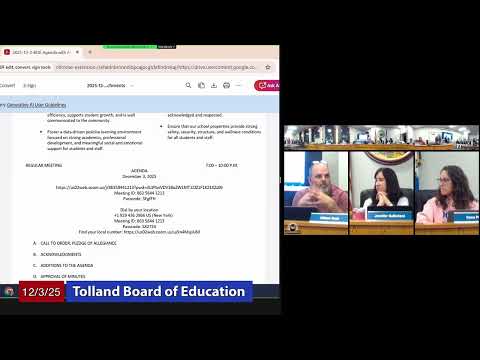
The board’s legal counsel, Jessica Ritter of Shipman & Goodwin, presented an extended legal orientation to the newly seated and returning members at the Dec. 3 meeting, outlining the statutory framework and practical rules governing local school boards.
Ritter emphasized that "as a board of education, you are an agent of the state," pointing to Title 10 of the Connecticut General Statutes as the basis for the board’s statutory responsibilities. She said board members act in a legislative, policy‑making function and should avoid unilateral administrative action outside posted meetings.
The attorney warned about confidentiality and legal exposure when board members seek or share information about individual students, personnel or DCF‑related matters. She cited FERPA and state confidentiality requirements that can bar administrators from sharing student disciplinary or special‑education details with board members until appropriate procedures (for example, an expulsion proceeding) require them to do so.
Ritter also reviewed Freedom of Information obligations: board members should use district email addresses for board business, retain records under the district’s retention policy, and avoid back‑channel communications when a quorum could be involved. "Don't put anything in writing that you wouldn't want anyone to see," she said, noting the commission can subpoena phone and computer records in some cases.
On social media, Ritter said members do not lose First Amendment rights but must not speak for the board unless authorized at a meeting and suggested a disclaimer when posting as private citizens. She recommended board email accounts and advised careful handling of attorney‑client communications and invoices.
Her briefing included multiple scenarios (subcommittee attendance, caucus vs. meeting, FOI requests, use of private email) and concluded with practical tips for new members about committee participation and using the board dashboard and portal for governance tasks.