Get Full Government Meeting Transcripts, Videos, & Alerts Forever!
Get email alerts on the Groundwater Management topic
No spam. Unsubscribe anytime.
GSA adopts 5% minimum-threshold option, expands monitoring network and amends criteria
Summary
The board selected a 5% domestic-well impact option for groundwater-level minimum thresholds, approved an updated representative monitoring-well network and amended the undesirable-results definition; staff presented mitigation-cost estimates and an inventory of domestic wells.
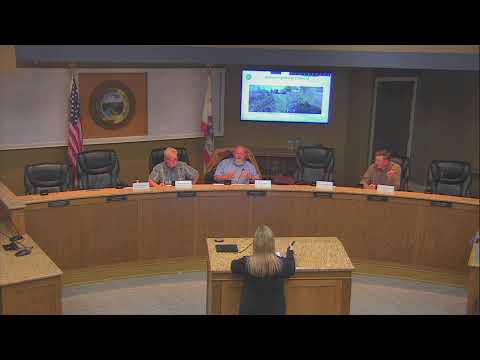
The Windrock Creek GSA on Nov. 20 voted to adopt a 5% option for groundwater-level minimum thresholds, approved an updated representative monitoring-site (RMS) network and amended the undesirable-results definition as recommended by consultants.
Becky Fairbanks, the GSA project manager, summarized the Department of Water Resources (DWR) review and consultant work. "You're gonna hear DWR's recommended corrective actions," Fairbanks said, noting one DWR request was to specify the number of domestic wells impacted at each minimum threshold.
Consultant Laura Falia (Larry Walker Associates) outlined the analysis and showed a domestic-well inventory and risk assessment. Falia said the consultant team identified roughly 792 domestic wells in basin records but, after excluding wells likely inactive and wells inside public water service areas, used about 360 wells for the risk assessment. She explained two alternative criteria for minimum thresholds — a percentile of nearby shallow wells (5th, 10th or 15th percentile) or a depth buffer below historical lows — and recommended using the deeper of the two approaches for each monitoring area.
Falia presented mitigation cost illustrations to help the board weigh options. Using a conservative estimate of $30,000 per well to deepen or replace a domestic well, she estimated that protecting a higher threshold would reduce the number of potentially impacted wells and lower long-term mitigation costs.
After discussion about geological variation and monitoring coverage, the board adopted the 5% option for the minimum threshold, approved the updated 10-well RMS network (adding two wells to improve coverage), and voted to amend the undesirable-results definition to the consultant's suggested language (two wells or 25%, whichever is greater, for representative monitoring selection and removal of the two-consecutive non-dry-year requirement). Motions carried by voice vote.
Next steps: staff will incorporate the 5% threshold and updated RMS into the Groundwater Sustainability Plan (GSP) periodic evaluation and continue to develop mitigation protocols, well-inventory refinement and long-term monitoring plans.