Get Full Government Meeting Transcripts, Videos, & Alerts Forever!
Get email alerts on the Water Funding topic
No spam. Unsubscribe anytime.
Windrock Creek GSA to pursue regulatory fee and two-part structure after stakeholder outreach
Summary
The Windrock Creek GSA voted Nov. 20 to pursue a regulatory fee with a two-part design: a per-parcel administrative fee and a per-cropped-acre groundwater fee. Board members asked for equity adjustments and a workshop to refine allocations before rates are finalized.
The Windrock Creek Groundwater Sustainability Agency voted Nov. 20 to proceed with a regulatory fee and a two-part fee structure that separates a parcel-based administrative charge from a per-acre groundwater use charge.
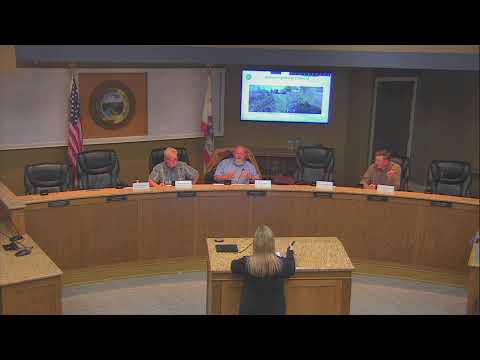
Catherine Hansford, the consultant who led the fee study presentation, said the structure is modeled on another local GSA and is intended to separate core administrative costs from groundwater-use costs. "The part 1 fee is a parcel fee," Hansford said. "A parcel fee means that everyone pays the same for a parcel." She said part 1 would cover items such as insurance, audits, legal fees and personnel.
Hansford described part 2 as a per-cropped-acre fee to capture costs tied to groundwater use. "The part 2 fee is per cropped acre. It is not the entire acreage of the parcel," she said, showing maps and crop-code data used to define cropped acres.
Board members and stakeholders raised equity concerns about how costs would be split between agricultural and domestic (municipal) users. One board member noted that municipal and industrial users represent a small percentage of groundwater pumping but could bear a large share of part-1 costs under some allocations. Hansford said those allocations have not been finalized, and the board retains annual discretion to adjust fees.
The board also discussed an adjustment for parcels receiving imported Feather River water. Hansford said parcels that rely on imported water, which contributes to basin recharge, "could pay a lower part 2 fee," and presented illustrative numbers showing small dollar differences in some domestic-user scenarios.
After discussion and public comment—including testimony from a Vina GSA board member who supported the model as equitable for large irrigators—the board approved a motion to proceed with a regulatory fee and a separate motion to adopt the two-part structure (part 1 parcel fee, part 2 to be refined). Both motions passed by voice vote. The board directed staff and the ad hoc group to continue work on equity adjustments and to prepare concrete budget and allocation scenarios for future decision.
Next steps: staff will pursue detailed budget forecasts and fee-allocation scenarios, coordinate an ad hoc workshop, and return with specific rates and guardrails for board review prior to any fee adoption.