Get Full Government Meeting Transcripts, Videos, & Alerts Forever!
Get email alerts on the Local Tax Policy topic
No spam. Unsubscribe anytime.
Augusta commission unanimously drops proposal to tax manufacturers' energy use
Summary
After testimony from the business community and manufacturers' trade groups, the Augusta‑Richmond County Commission unanimously agreed not to impose a proposed excise tax on energy used by manufacturers, removing an estimated $2 million in revenue from the FY2026 options list.
Augusta‑Richmond County commissioners unanimously removed a proposed excise tax on energy used by manufacturers from consideration during their Nov. 25 meeting after extended testimony from the local chamber of commerce and the Georgia Association of Manufacturers.
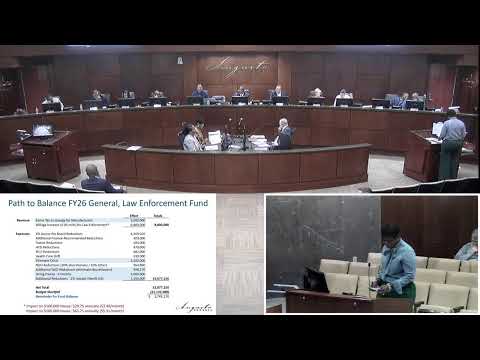
Administrators had placed the excise tax on the table as one of several revenue options to help balance the FY2026 general and law‑enforcement funds. The administration described the option as a replacement local excise available after the state eliminated sales taxes on manufacturing energy; staff estimated the local excise could yield about $2,000,000 if adopted.
The Augusta Metro Chamber of Commerce and the Georgia Association of Manufacturers urged commissioners not to adopt the tax, arguing it would harm competitiveness and job growth. Angie Cox, president and CEO of the Augusta Metro Chamber, told the commission the chamber’s members and local economic development partners supplied data showing local manufacturers helped grow jobs and investment and asked the commission to "keep energy used in manufacturing... tax free." Clay Jones, vice president and general counsel for the Georgia Association of Manufacturers, said the state‑level reform that began in 2013 helped attract manufacturing investment and warned an excise tax would "make your manufacturers less competitive" and create tax pyramiding.
Commissioners debated the policy and economic arguments before Commissioner Brandon Garrett asked for the item to be removed. The chair then called for a show‑of‑hands consensus; the body recorded a unanimous decision not to adopt the excise tax.
Administrators acknowledged the decision would leave a revenue gap in the FY2026 options list and said staff would return with alternatives to close the roughly $2 million shortfall. The commission recessed to executive session later the same day to continue budget deliberations.
What happened next: the commission moved on to discuss other options for balancing the budget, including cuts and potential limited millage changes.