Get Full Government Meeting Transcripts, Videos, & Alerts Forever!
Get email alerts on the Tree Code Amendments topic
No spam. Unsubscribe anytime.
Council reviews tree-code concepts to align with Oregon housing law and preserve canopy
Summary
Consultants and staff presented four core code concepts — clear-and-objective standards for housing-related tree permits, exemptions and small-lot rules, incentives (native-tree credits, possible dimensional flexibility and stormwater credits), and a streamlined appeals path — and the council debated thresholds, fee-in-lieu calibration and homeowner options for moderate-risk trees.
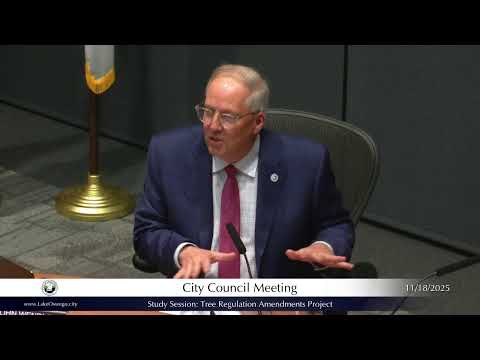
Consultants from Cascadia Partners and city staff briefed the Lake Oswego City Council on an update to the city’s tree regulations on Tuesday, framing the work as a targeted effort to comply with recent state requirements while preserving the community’s tree canopy.
Sarah Goldstein, a Cascadia Partners consultant, said the project’s objective is "to amend Lake Oswego’s tree code and tree related provisions in the community development code as recommended by the urban community forestry plan update" and to preserve the city’s wooded character while supporting responsible development. The presentation focused on four substantive code concepts: (1) creating clear-and-objective standards for "needed housing" applications to comply with Oregon law, (2) creating incentives for preservation, (3) evaluating the appeals process to reduce delay, and (4) aligning development and non-development permit approaches.
Under the first concept, applicants for housing development would be allowed to choose between two measurable preservation tracks: retain a percentage of trees on a lot or retain a percentage of total DBH (diameter at breast height). The proposal also includes an exemption for trees found within the building envelope on small lots (examples discussed: lots 5,000 sq. ft. or less or lots up to 15% above zone minimum). Consultants used 15-inch DBH as an example threshold because that number currently separates Type 1 and Type 2 permits in existing city rules.
Councilors raised several policy questions: how to set retention percentages (33% and 50% were shown as placeholders), whether the small-lot exemption would unfairly privilege certain lot classes, and whether a clear-and-objective path should be limited to housing development or apply to all Type 2 permits. Staff emphasized the state law driver (citing HB 2138) that requires a clear-and-objective track for housing, and the consultant recommended maintaining a two-track system: a clear-and-objective track for housing projects and a discretionary track for other removals.
On incentives, the consultants proposed bonus credits to encourage preserving native or high-value trees (for example, a 125% DBH credit for certain natives) and discussed two possible incentives: modest dimensional adjustments for applicants that meet high retention thresholds, and stormwater-credits for on-site tree retention. Councilors were skeptical about granting dimensional variances as an incentive but broadly supported exploring stormwater credits; staff said the stormwater credit concept is in the staff report and is being vetted with engineering.
The team also proposed shortening the notice-and-appeal window from three weeks to two weeks for clear-and-objective applicants and routing appeals to a qualified hearings officer — with debate among councilors over whether to preserve city-council appellate review. Some members argued a hearings officer would speed decisions and reduce politicization; others stressed elected oversight and the right of residents to appeal to council.
Finally, the consultants proposed a new exemption to allow removal of moderate-risk trees when a qualified arborist confirms the tree is moderate risk and risk-reduction measures are infeasible. The tree task force generally supported this path but asked for guardrails to avoid excessive removals.
Staff outlined next steps: present the council’s direction to the Planning Commission on Dec. 8, draft code amendments for further review, refine numeric thresholds with case studies and data, and update the 'significant tree' definition as part of the technical work list. Staff also reported baseline tree data: over the last five years the city permitted approximately 2,930 tree removals per year on average; about 16% (≈461 trees per year) were linked to development-related permits, and last year roughly 689 replantings were required as mitigation; parks reported planting more than 20,000 trees this year as part of broader canopy efforts.