
City weighs sale and reuse of Center Street Public Works site; commission leans to medium‑density rezoning and further study
Get AI-powered insights, summaries, and transcripts
Subscribe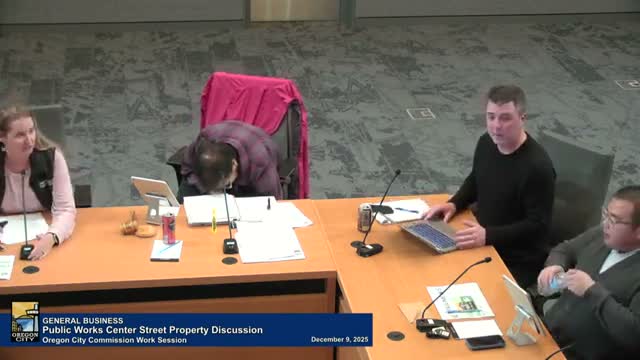
Summary
Staff outlined three disposition paths for four Center Street tax lots: sell as‑is, moderate mitigation, or full cleanup and demo (estimated $400,000–$500,000). Commissioners signaled support for rezoning to medium density (R‑3.5), asked for Phase I/II environmental and title reports, and discussed packaging parcels to enable workforce‑housing partnerships.
City staff gave the commission a detailed briefing on four tax lots that make up the Center Street Public Works property and asked for direction on zoning and how much remediation and site work to do before sale or redevelopment.
"This site is about 1.07 acres," Public Works Director Dana Webb told the commission, describing the main operations yard, the Cameron Building (a separate 0.13‑acre tax lot), and two adjacent parking lots. Staff said parts of the site are constrained by a 250‑foot landslide buffer and by recorded easements (a public sewer lateral that runs under the structure and a 2020 overhead power easement that bisects usable yard space).
Staff presented three disposition approaches: A) sell as‑is with minimal prep (unlikely to attract many buyers), B) moderate mitigation (selective demo and easement negotiations) and C) a clean‑slate option involving demolition, easement relocation and extensive environmental cleanup. Staff estimated the cost to demolish and mitigate the most constrained site could be in the "$400,000–$500,000 range" and noted two open DEQ files relating to historic underground storage tanks on the Cameron Building/lower yard that require Phase I/II investigation.
Commission discussion focused on zoning and housing goals. Several commissioners supported rezoning the parcels to medium density (R‑3.5) to better align with neighborhood pattern and to make workforce or starter‑home options feasible. Commissioners explored packaging the four lots so market‑rate sales of the simpler parking parcels could offset remediation costs on the lower yard, or else pursuing partnerships (Habitat for Humanity, land trusts, or Clackamas County housing partners) and using affordability covenants or disposition agreements to preserve workforce units.
Staff said funds used to purchase parts of the property (transportation funds that paid for the Cameron Building purchase) would need to be reimbursed on sale. Commissioners directed staff to obtain title reports, complete Phase I/II environmental work and hazardous‑materials studies, and return with refined cost estimates and a plan (including an RFP/RFQ outreach option) so the commission can decide whether to sell parcels separately or package them as a mixed project.
Next steps: staff will order title and environmental reports, engage potential partners for options analysis, and return with more detailed financial and program recommendations; no sale was authorized at the work session.