Get Full Government Meeting Transcripts, Videos, & Alerts Forever!
Get email alerts on the Multi Discharge Variance Funding topic
No spam. Unsubscribe anytime.
Committee forwards $19,370 phosphorus cost‑share allocation to county board amid questions about impact
Summary
Adams County’s Conservation Committee voted to send a multi‑discharger variance funding allocation (about $19,370) to the county board. Members asked for clearer impact metrics (percentages vs. pounds) and raised concerns that grant language could favor larger, modern farms over smaller 'old school' operations.
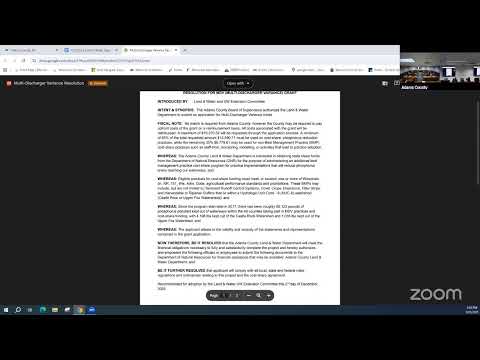
The Adams County Conservation Committee voted to forward a resolution that would allow the county to accept and administer an estimated $19,370 in multi‑discharger variance funding aimed at reducing phosphorus in surface waters.
Land and Water staff described the allocation as roughly $19,370 in total, of which about 35% (approximately $6,700) could be used for administration and the remaining 65% (about $12,590) would be used for cost‑share to implement phosphorus‑reducing agricultural practices. Staff said the Department of Natural Resources secured approval to extend the funding window through 2035 and that eligible practices must meet or exceed NR 151 agricultural performance standards.
Committee members asked for clearer performance metrics. One member noted the resolution references 58,000 pounds of phosphorus kept out of waterways and asked whether a percentage baseline or comparable metric could be provided; Colton said a detailed 72‑page document exists and he would share percentage figures. Colton also offered a different figure when speaking about the last eight years, saying Adams County had kept more than 5,000 pounds out of its HUC‑8 watersheds and that Adams County accounted for about 10% of pounds among participating counties.
Some supervisors, including Raja Postovsky, expressed concern that the funding language could advantage larger, modern operations already equipped for runoff controls and put smaller, older farms at a disadvantage. Colton and the chair responded that the funds are allocations to producers (cost‑share) and are not drawn from the county’s operating budget.
The committee moved the resolution to the county board (mover: Supervisor Halmstad; second: Citizen Morgan) and voted to forward it; Supervisor Posdowski recorded a 'nay.' Staff committed to sharing the detailed metrics and baseline data with committee members.
Why it matters: The funds provide local producers access to cost‑share for phosphorus reduction practices that affect water quality in local watersheds and can influence which practices are prioritized on the landscape.
What’s next: The resolution will be considered by the Adams County Board; staff will provide committee members and the public with the underlying data referenced in the presentation.