Get Full Government Meeting Transcripts, Videos, & Alerts Forever!
Get email alerts on the Sfrf Session Law topic
No spam. Unsubscribe anytime.
Session law 2025‑97 lets North Carolina agencies swap unspent SFRF for one‑time general‑fund dollars, NCPRO says
Summary
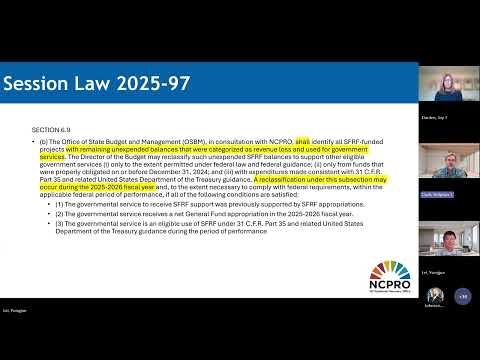
NCPRO director Tommy Clark told state agencies that session law 2025‑97 allows a limited, dollar‑for‑dollar general‑fund swap for unspent State Fiscal Recovery Fund (SFRF) revenue‑replacement projects and requires NCPRO to report unexpended balances to the General Assembly by April 15.
Tommy Clark, director of NCPRO, told a state interagency meeting that session law 2025‑97 gives North Carolina limited flexibility to replace unspent State Fiscal Recovery Fund (SFRF) dollars in revenue‑replacement projects with one‑time general‑fund appropriations.
Clark said the law applies only to projects categorized as revenue replacement under the SFRF codification and warned it does not permit new projects. “This is not gonna be free general fund money. This is to finish out your projects,” Clark said, adding that the swap would be a dollar‑for‑dollar replacement and not a permanent budget increase.
Under section 6.9, NCPRO must report to the General Assembly all unexpended balances for SFRF revenue‑replacement projects as of 12/31/2025; Clark said that report will be due no later than April 15 (the session law links the April deadline to the unexpended balances reported as of 12/31/2025). The reporting requirement will let budget writers and lawmakers identify projects that could be reclassified or receive nonrecurring general‑fund dollars to complete existing work.
Clark described how the swap would work in practice: NCPRO would close a project, remove the unexpended SFRF dollars, and increase the agency’s nonrecurring general‑fund appropriation to cover the remaining costs, with agencies expected to use the general‑fund money “for the current project intent.” He advised agencies that projects on track to spend their SFRF awards by 12/31/2026 should generally finish with SFRF rather than pursue a swap to reduce paperwork.
During questions, Daryl asked whether the Science Museum program fits the revenue‑replacement category; Clark said most of their projects do. Mark asked whether a state agency could receive additional funds from other agencies that cannot spend theirs; Clark recommended agencies identify projects that need more funding in the NCPRO report and raise the issue with budget writers when the legislature returns.
Clark said grant managers will confirm project status through December 2025 via normal accountability calls and additional email outreach so NCPRO can compile an accurate report to the General Assembly and identify candidates for reclassification. He said the office plans to continue monthly meetings on this topic.
Clark also told attendees that the NCPRO office was created by the General Assembly during the pandemic and is scheduled to sunset on 06/30/2026. He said the staff and functions will likely continue under the Office of State Budget and Management (OSBM) until final closeout and reporting are complete.