Get Full Government Meeting Transcripts, Videos, & Alerts Forever!
Get email alerts on the Housing Affordability topic
No spam. Unsubscribe anytime.
Brookhaven staff proposes tighter workforce-housing rules and a fee-in-lieu option
Summary
City staff proposed revising Brookhaven’s workforce-housing definition to target households at 60%–80% of area median income, increase mandatory set-asides and add a one-time fee-in-lieu option; the measure will go to the planning commission in January for review.
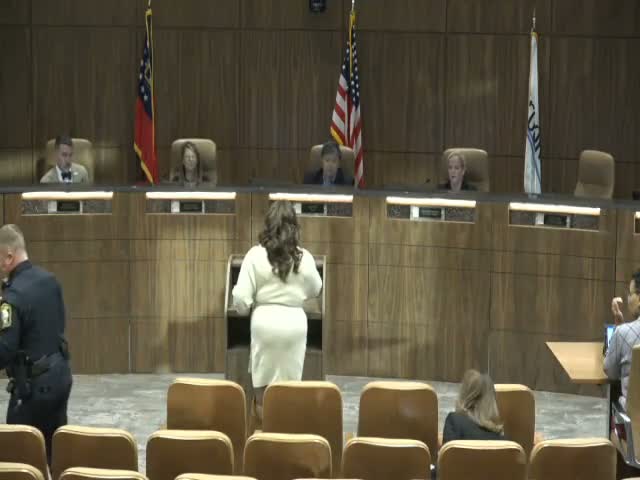
Brookhaven city staff on Nov. 18 outlined proposed changes to the city’s workforce-housing rules intended to target lower-income renters and expand long-term affordability.
Rhonda, the staff presenter, said the city currently treats “individuals and households earning 80% to 100% of the area median household income” as eligible for workforce housing and that the 2018 zoning rewrite requires multifamily rezonings or special-use permits to set aside at least 10% of units at or below 80% AMI. "A 1-person household at 60% AMI earns roughly $48,000 per year," she said, and cited HUD-derived maximum rents — about $1,200 for an efficiency at 60% AMI and $1,600 for a one-bedroom at 80% AMI — while noting the current market-rate rent in Brookhaven averages above $1,800.
Staff reviewed developments that have complied with the city’s set-aside requirement: Bellamy Executive Park (345 units, 35 required workforce units; staff reported 27 currently occupied as workforce units), Amlee Brookhaven (phased construction, about 63 proposed workforce units, with roughly 35 occupied in early phases), Manor Druid Hills, Panorama and Corporate Square. Rhonda said the city will return in January with a formal text amendment that would (a) revise the workforce-housing definition to emphasize incomes between 60% and 80% AMI, (b) consider increasing mandatory set-aside levels (staff cited possible language including 10% of units at or below 60% AMI and 15% at or below 80% AMI), and (c) add a one-time fee-in-lieu payment as an alternate compliance option to create a dedicated fund for future affordable housing work.
Council members asked for technical details staff will bring back. One council member asked whether the fee-in-lieu could be calculated as a long-term formula (for example, amortized over 20 years) rather than a single-year figure; Rhonda said staff will present a calculation method when the amendment returns. Another council member asked how long deed restrictions must remain in effect; Rhonda said the current zoning language requires deed-restriction set-asides for a minimum of 20 years.
Several council members voiced caution about a buyout (fee-in-lieu) option. One asked, “Do we feel like the buyout option is gonna undermine our 10% set aside,” warning that a low fee could encourage developers to pay instead of building units. Staff and other members discussed safeguards such as limiting eligibility for the fee, setting the fee at a level that incentivizes on-site units, creating a trust or municipal fund to deploy money quickly to build units, and conducting periodic reviews of the policy’s outcomes.
Rhonda said the draft language will proceed to the Planning Commission in January and return to the council after that review. No ordinance or binding decision was adopted at the Nov. 18 work session; the discussion will continue when staff brings proposed amendment text and a fee-calculation method.
The council’s next procedural step is the planning-commission review scheduled for January; staff emphasized it will include specific calculations for any fee-in-lieu and proposed deed-restriction terms.