Get Full Government Meeting Transcripts, Videos, & Alerts Forever!
Get email alerts on the Land Use Subdivision topic
No spam. Unsubscribe anytime.
Mount Juliet planners defer Oakmont (Kiel) subdivision after discovery of unnamed cemetery, infrastructure concerns
Summary
The Planning Commission deferred action on the proposed Oakmont/Kiel RS‑20 subdivision after commissioners and staff raised concerns about lot buildability, long cul‑de‑sac lengths, sewer options and an 'unnamed cemetery number 17' noted by the Tennessee Historical Commission. The applicant requested time to address the issues.
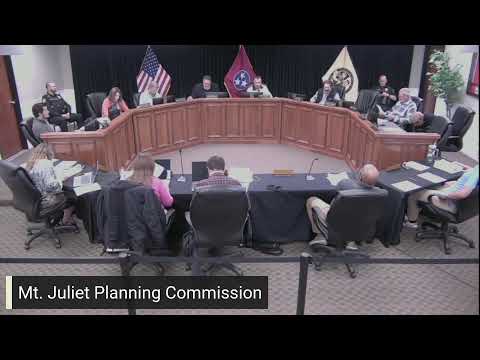
Mount Juliet — Mount Juliet’s Municipal and Regional Planning Commission voted on Nov. 20, 2025 to defer consideration of the proposed Kiel (Oakmont) preliminary master development plan after an extended review that centered on a previously undocumented cemetery and several engineering and design concerns.
Planning staff described the proposal as an RS‑20 pod on about 10.32 acres with roughly 15 single‑family lots. Staff noted the project meets minimum area requirements for a pod but flagged several issues: limited improved open space (staff noted 7% as proposed), potential flood‑plain impacts on northern lots, questions about whether lots are buildable as drawn, cul‑de‑sac length and whether sewer service can be provided by gravity or will require grinder pump systems with redundant backups.
Jill (planning staff) said the site contains a documented burial site listed by state reviewers as “unnamed cemetery number 17.” She told the commission that the Tennessee Historical Commission and the State Historic Preservation Office prohibit disturbance within 10 feet of known graves but recommend a 30‑foot buffer where undocumented graves are suspected; staff said they would conduct field visits and coordinate with the state to locate and document graves before the project returns for further review. “There have been notes where they said that some cities and counties have chosen to maintain these unnamed cemeteries,” Jill said, and staff planned lidar/field work and further research with the State Historic Preservation Office.
Commissioners also raised infrastructure questions. Public‑works staff said they prefer gravity sewer service where feasible and will ask the applicant to investigate connecting through existing HOA infrastructure; if a grinder system is necessary, staff requested redundant systems and public easements to allow long‑term municipal maintenance. Commissioners repeatedly asked that questionable lots be combined or redesigned so homes can be sited with adequate building envelopes.
Developer representatives asked for time to gather the requested information. Hayden Deberry, representing the applicant’s engineering firm, acknowledged several of the technical items could be addressed with additional study and indicated the applicant would work with staff. The applicant requested a deferral; the chair accepted an indefinite/30‑day deferral at the applicant’s request so staff and the developer could complete the cemetery research, confirm sewer options, and return with revised lot configurations and narrower lists of outstanding items.
What’s next: Staff will coordinate with the Tennessee Historical Commission on field work to better identify any burial sites and advise the applicant on buffer requirements and appropriate protections. The item will return to the Planning Commission when the applicant and staff have completed the follow‑up work and are ready to present revised plans.