
Residents and commissioners spar over options to stabilize eroding NC 12; expert public comment urges immediate reconstruction of historic groins
Get AI-powered insights, summaries, and transcripts
Subscribe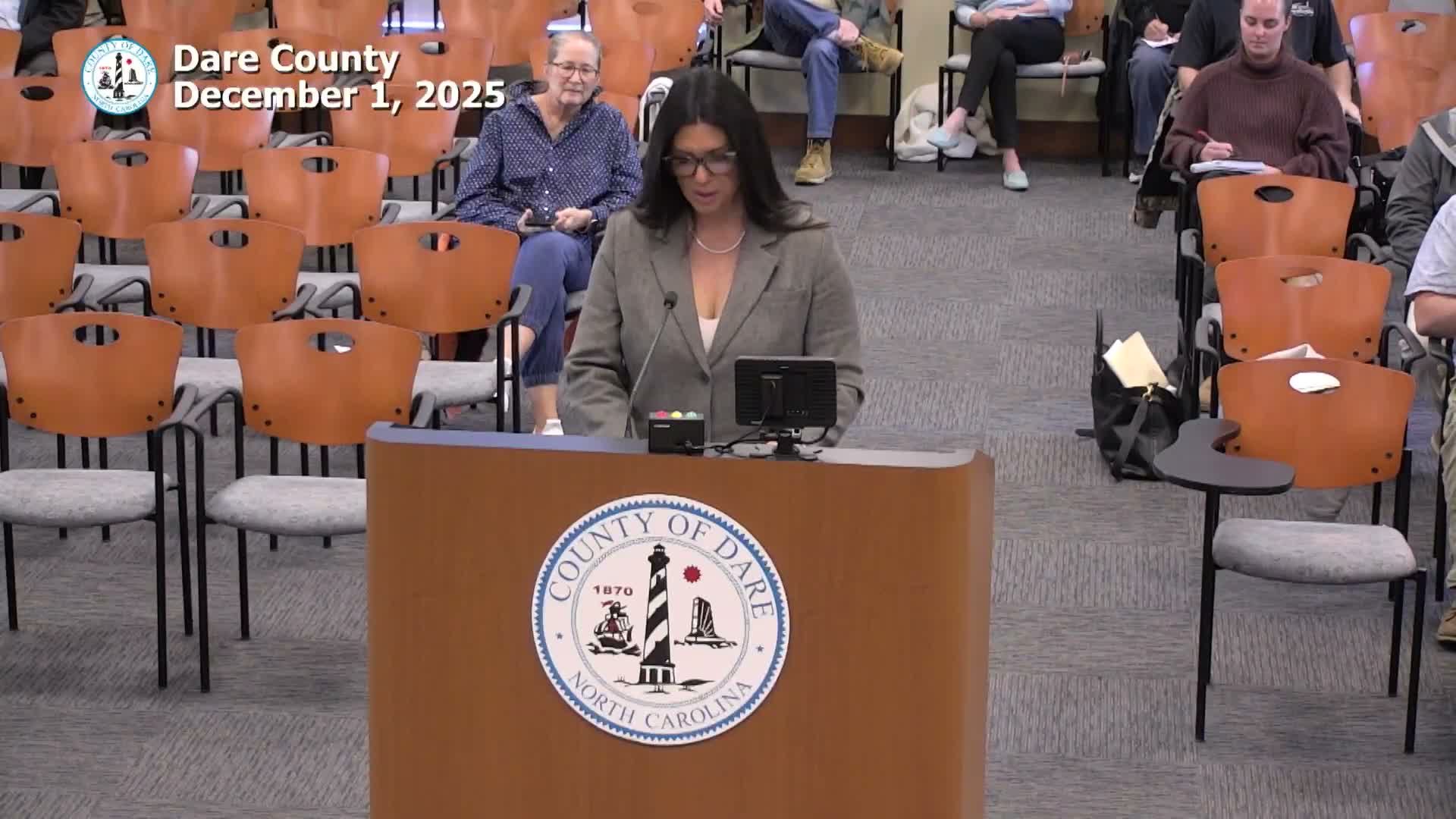
Summary
At the Dec. 1 Dare County Board of Commissioners meeting, resident Christine Drummond urged immediate reconstruction of three historic groins to stabilize North Carolina Highway 12, citing state statutes and administrative rules; county staff said permitting, a 50% repair rule and funding constraints limited options and that agencies are reviewing a single-groin application.
Christine Drummond told the Dare County Board of Commissioners on Dec. 1 that portions of North Carolina Highway 12 and nearby shoreline communities face accelerating erosion and urged the county to pursue immediate reconstruction of three Navy-built groins at the FUD site.
Drummond asserted a legal pathway to rebuild the groins, saying the law allows restoration of historically existing erosion-control structures. “Under GS 1 13 a through 1 15.114 N.C., erosion control structures that historically existed and served a public purpose may be reconstructed or replaced within their original footprint,” she told the board, and she urged a formal board resolution, joint legislative hearings and a 30/60/90-day environmental review.
Her plea framed the central debate at the meeting: whether Dare County should pursue reconstruction of hardened structures — a move supporters say is necessary to protect the highway and island communities and opponents say could redistribute erosion downcoast. Drummond argued federal ownership of the FUD site does not bar county action and that federal agencies must comply with state coastal policy.
County staff answered that permitting and engineering constraints limit what the county can do without state approvals. The county manager explained that state permitting includes a 50% rule that constrains repair and reconstruction of substantially deteriorated structures and that the county’s engineers and permitting agencies are reviewing applications that currently seek a single groin repair. “We looked at trying to do multiple groins, and there's a 50% rule that applies to repair a groin,” the manager said. He added the applications are before the permitting agencies and that funding to build three groins would be substantial.
Commissioners asked engineers and staff about the likely effects of adding groins. The county manager described the mechanics: a groin traps sand moving from north to south and can increase scour or erosion to the south if not paired appropriately. He said engineers told the board a single reconstructed groin would provide localized benefit but rebuilding more structures would create complex trade-offs and greater cost.
Board members and the county manager also noted next steps would require technical analyses and agency approvals. Drummond urged immediate, public action — including a formal resolution and legislative hearings — while staff recommended continuing technical work with permitting agencies and seeking funding pathways.
The meeting ended without a formal county resolution on reconstruction; commissioners indicated they were awaiting permitting determinations and engineering guidance before authorizing further action.