Get Full Government Meeting Transcripts, Videos, & Alerts Forever!
Get email alerts on the Short Term Rentals topic
No spam. Unsubscribe anytime.
Riley County planners propose 500-foot STR separation, require in-person 1-hour response
Summary
Planning director Amanda Webb presented proposed short-term rental amendments calling for a 500-foot separation between STR units, an in-person responsible-agent response within one hour for complaints/emergencies, and proof that STR properties are current on taxes and fees. Commissioners asked for clearer standards for staff discretion.
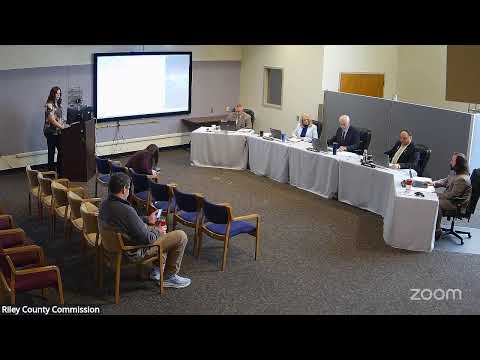
Amanda Webb, Riley County planning director, presented a package of short-term rental (STR) code changes at the Nov. 17 Riley County Commission meeting that would establish a 500-foot separation between STR units, require a responsible agent to respond in person within one hour to complaints or emergencies, and require that properties hosting STRs be current on all applicable taxes and county fees.
The proposals, the product of multiple planning-board workshops this year, modify earlier language that measured separation between properties. Webb said measuring 500 feet between units — rather than between property boundaries — gives flexibility for larger parcels while still targeting denser neighborhoods where parking and traffic become concerns. Webb said the code would apply to new STR licenses; existing licensed units closer than 500 feet would be allowed to remain if they keep their licenses current.
The planning boards also recommended a limited staff-review exception for some cases in which two licensed units fall within 500 feet but access from separate streets means they would not likely affect each other. Webb said the exception is intended to allow staff to consider site-specific factors rather than applying a rigid blanket rule in every case.
Commissioners pressed Webb on how staff would apply that discretion. One commissioner cautioned that a broadly worded staff exception could be perceived as arbitrary without clear standards. Another asked whether the responsible-agent requirement meant that an agent must appear in person for any complaint; Webb said the intention is an in-person response at the property within one hour for complaints rising to the level of an emergency (for example, when police are called). For minor service requests — a missing towel, she said — an in-person response would not be expected.
Webb explained the draft ties the 12-month license/renewal language to the countynonconformities clause used elsewhere in the code: if a license lapses for more than 12 months the nonconformity could end the ability to continue that use. She said staff can tighten the language to reduce uncertainty before the commission takes a final vote.
No final action was taken on the amendments at the meeting; commissioners asked staff to return with more specific standards for when the staff-review exception would apply and clearer language about the in-person-response requirement. Webb said she and staff will revise the draft and work with the planning board and county counsel as needed before bringing it back to the commission.
Next steps: staff will prepare revised language addressing the commissionersquestions about administrability and thresholds for the staff exception; no public hearing or vote date was set during the meeting.