Get Full Government Meeting Transcripts, Videos, & Alerts Forever!
Get email alerts on the Forensic Hospitals Discharge topic
No spam. Unsubscribe anytime.
State hospital chief outlines why forensic admissions and discharges are delayed, points to paperwork and benefit gaps
Summary
Laurie, a chief overseeing five state hospitals, told a Baltimore County coordinating council that triage rules, limited high‑security beds, documentation gaps and slow SSI processing are lengthening waits and complicating safe discharges back to the community.
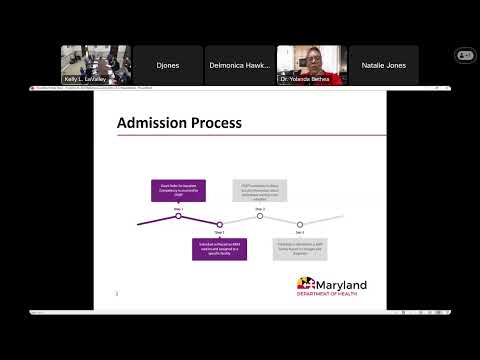
Laurie, who identified herself as the chief responsible for five state hospitals, told the Baltimore County coordinating council that admission and discharge timing is driven by legal triage, charge level and bed availability, not simply administrative delay. She said court orders come through MDEC and OSEP, then are tagged and placed on a wait list; high‑felony charges are routed to Perkins, which has a small number of maximum‑security beds and creates a bottleneck for those patients.
Laurie cited the Maryland appellate decision Hawkes v. Maryland to explain a key constraint: “the plan that the doctor signs off on has to mitigate the risk,” she said, meaning hospitals must document how returning someone to the community will not create unacceptable risk. That requirement, she said, can lengthen discharge planning for people with serious charges or complex needs.
She described two parallel tracks that govern when a patient leaves a state hospital. The legal track involves reevaluation by a court—patients are reevaluated every six months and court decisions determine whether someone remains committed. The clinical track focuses on diagnosis and stabilization; Laurie said substance‑use effects, especially from synthetic drugs, have stretched clinical recovery from weeks to many months in some younger patients.
Beyond clinical readiness, Laurie said providers will not accept new patients unless they know how the patient will be paid. She highlighted slow benefits activation as a persistent obstacle: Maryland ranks poorly on Social Security/SSI processing speed, and federal furloughs and backlogs have lengthened the time before benefits pay providers. “So benefits are a big issue as far as getting folks out,” she said.
Laurie also described documentation problems that delay discharge for some groups. If an arrestee lacks a state ID or immigration paperwork, replacing those documents can take months; DDA (Developmental Disabilities Administration) eligibility requires historic school or medical records that may no longer be available, leaving some people ineligible for needed residential supports. She urged local intake teams to forward available IDs and paperwork with detainees to shorten verification time.
Laurie outlined opportunities to reduce delays: richer prescreen packets from county intake, consult calls between hospital and community providers, placement interviews to prepare clients, transitional visits to rebuild skills lost during prolonged hospitalization, grant‑funded community navigators for discharge planning, and a single social‑work point for 30/60/90‑day follow up.
She gave discharge numbers for the reported period (for context): Perkins 843, Eastern Shore 487, Spring Grove 390, Springfield 293, Thomas V. Finance Center 36, and 418 Baltimore County discharges overall. She said some people discharged to shelters or who refuse services cycle back into care most often, and that conditional releases monitored by Community Forensic Aftercare Program (CFAP) include reporting to courts and prosecution when community treatment breaks down.
The presentation concluded with a request for county partners to improve information flow at arrest and intake to reduce months of administrative delay and to consider program supports—such as navigators and transitional visits—that make community placement durable.