Get Full Government Meeting Transcripts, Videos, & Alerts Forever!
Get email alerts on the Subdivision Ordinance topic
No spam. Unsubscribe anytime.
Norwalk council gives first reading to require subdrains and granular subbase for new streets
Summary
On Nov. 20 the Norwalk City Council gave first reading to an ordinance that would require subdrains and a granular subsurface for all new streets, with a phased start date tied to plats approved on or after Jan. 1, 2026; council and developers debated cost-sharing and bond language.
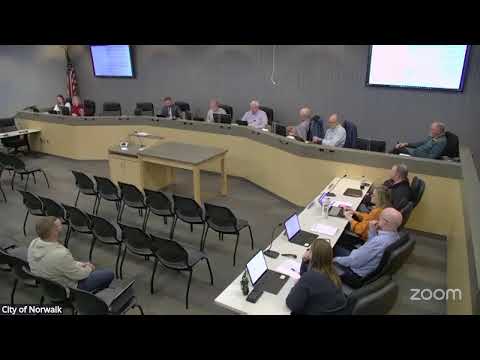
Norwalk City Council gave first reading Nov. 20 to an amendment to the city’s subdivision ordinance that would require subdrains and a granular subsurface for all new streets, a change staff said will extend pavement life and reduce long-term maintenance costs. Mayor Phillips introduced the ordinance and explained the measure updates design standards, road-construction requirements and warranty and maintenance-bond provisions.
City staff described engineering findings and lifecycle savings. Wayne, a city staff member, summarized a 2017 pipe-and-pavement study and said the investment pays off: "So it's almost a 4 to 1 cost savings," he said, arguing a uniform base and subdrain reduce moisture-related failures and cracks. The ordinance also removes a bonding requirement for design work while keeping bonds for workmanship, installation and construction.
The ordinance includes a staggered phase-in. Staff said the new standard will apply to preliminary plats approved after Jan. 1, 2026, or to final plats approved after that date, to avoid penalizing multi-phase developments already under way. Council asked staff for a follow-up status report on active developments so members can see which preliminary plats may be affected.
Developers and residents offered public comment. Dave Harmier of Vista Real Estate said his Saddle Ridge schedule and permitting timeline make the phase-in difficult to meet; "it's probably to cost more like 5 to 6%" for his project, he said, challenging staff's smaller incremental estimate. City staff and councilors discussed a possible city cost-share for developments not yet built out and asked staff to model the number of affected streets and fiscal impacts.
After further questions about per-lot savings and bonding details, Council member Baker moved and Council member Coole seconded approval of the ordinance’s first reading. The motion carried on the recorded vote.
Next steps: this was the first of three readings; council reserved further discussion on cost-sharing and transition language before later readings.