
Kingsburg council declines to affirm 88-unit allocation after residents raise outreach, safety and annexation concerns
Get AI-powered insights, summaries, and transcripts
Subscribe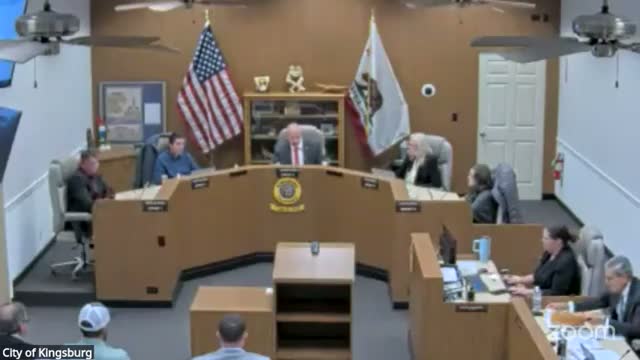
Summary
After a public hearing with lengthy resident opposition, Kingsburg council declined to affirm Planning Commission’s recommendation to award 88 housing allocations to San Joaquin Valley Homes, citing inaccurate applicant outreach materials and unresolved annexation, safety and infrastructure questions.
The Kingsburg City Council on Dec. 3 declined to affirm the Planning Commission’s recommendation to award 88 housing‑unit allocations to San Joaquin Valley Homes, after residents raised repeated concerns about outreach accuracy, safety near existing homes and uncertainty over annexation and utility costs.
Community Development Director Holly Owen opened the public hearing, describing the growth‑management allocation system adopted by voters in the mid‑2000s; the system makes 115 allocations available annually (80 single‑family and 35 multifamily) and requires applicants to receive allocations before proceeding to environmental review, tentative map, planned‑unit development and, where required, annexation subject to Fresno LAFCO review. Holly Owen said the project is an 88‑lot proposal on about 29.65 acres with minimum 7,000‑square‑foot lots and a conceptual internal park; allocations, she said, are the first of many steps and would not by themselves approve a final map or annexation.
The applicant, identified in the record as a San Joaquin Valley Homes representative, requested all 88 allocations and told council the submittal was conceptual and would move through environmental review and annexation processes if allocations were granted.
Residents who live near the project area—several of whom said they are county homeowners that would be annexed—mounted an extended objection. Paul Nelson said the conceptual map leaves easements and “dead” open space adjacent to existing yards that could be used for homeless encampments and would be difficult for police to patrol; he added the area sits near Reagan Elementary School and could endanger children. Several neighbors said they had not received notices or maps, disputed a chart in the applicant’s packet showing owners’ positions (yes/no/unknown), and called that chart inaccurate or misleading.
"That is not accurate at all," one resident said of the submitted owner‑response chart; another said, "That's a straight up lie," during public comment. Larry King, who had supplied the chart, said it represented informal conversations with property owners over a five‑year period and was not a scientific survey.
Residents also raised infrastructure concerns: multiple speakers said private wells in the area have been declining and warned of substantial costs if homeowners are later required to connect to city water or sewer. One resident said a quoted sewer connection estimate was about $25,000. City staff and the city attorney told council that many of those questions would be addressed during environmental review, tentative map and LAFCO annexation steps, and that LAFCO routinely examines outreach and orderly boundary issues.
Council members noted a tension between following the voter‑approved allocation ordinance and listening to current resident concerns. Several members said the applicant had met the technical requirements in the ordinance packet; others said the presence of what appeared to be inaccurate outreach information in the application and unresolved annexation and safety issues weighed against affirming allocations. A motion to phase the allocations (48 in 2026 and 40 in 2027) was made but failed for lack of a second. Council then moved to not affirm (effectively deny) the Planning Commission recommendation; that motion carried, so the council did not adopt the resolution to award the 88 allocations.
The council and staff emphasized that denying the allocations at this hearing does not stop the administrative processes that will need to be satisfied should the developer ultimately reapply or pursue other avenues; the city attorney and staff said future steps would include environmental review, tentative map, development agreement review and, if annexation is requested, LAFCO evaluation.
Council members and staff said they want better outreach to affected property owners and clearer answers about the maintenance of easement areas, public safety coverage and potential utility hookup costs before moving allocations forward. The council did not adopt Resolution 2025‑065, the Planning Commission’s recommended allocation resolution.
The matter may return to the council in a revised form if the developer pursues the subsequent steps required in the ordinance and CEQA process.