Get Full Government Meeting Transcripts, Videos, & Alerts Forever!
Get email alerts on the Sanctuary Policy topic
No spam. Unsubscribe anytime.
County staff propose resolution and ordinance options to strengthen sanctuary policies amid increased ICE activity
Summary
Staff presented a menu of policy options for a sanctuary-strengthening package, including clarifying detainment/custody steps, prohibiting use of county funds for immigration enforcement, signage and training, employee leave and telework options, data-privacy protections, and possible limited funding for community supports.
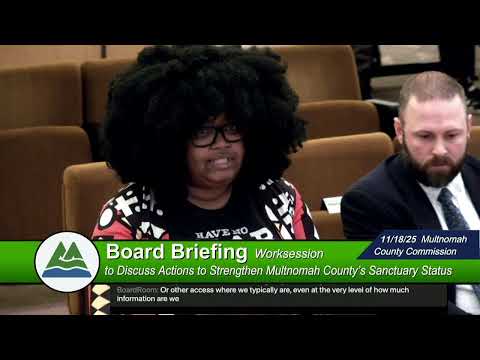
Multnomah County staff briefed commissioners on options to strengthen the county's sanctuary commitments after a reported rise in ICE enforcement activity, presenting legal and operational buckets for a resolution and a potential ordinance.
Garrett Pryor, senior policy adviser, summarized the goal: "The key outcome we're driving towards is a resolution and ordinance and then some type of funding action, or programmatic work," he said. Staff canvassed other jurisdictions (New York City, San Francisco, Cook County) and pulled policy ideas into five broad areas: clarifying detainment and custody-hold procedures; prohibiting use of county funds for immigration enforcement; strengthening employee protections, training and telework options; limiting collection and disclosure of immigration-status data; and prohibiting county contracts to operate detention facilities.
Presenters emphasized a dual-track approach: use a resolution to set context, history and values, and an ordinance to impose specific operational constraints and protections. Staff asked for board guidance on what policy areas to prioritize for drafting and legal review.
Staff reported increased enforcement activity and community disruption: "In last month alone, there was about 300 community members taken by ICE agents in the state," a presenter said, adding that schools and county programs have experienced lockdowns and elevated fear among employees and service users. Commissioners pressed for clarity on which actions could be implemented quickly and which would require interdepartmental coordination or bargaining with unions.
Policy options the staff flagged as lower-cost or operationally feasible in the near term included enhanced signage and targeted training for county employees, clearer department-level guidance on restricted/unrestricted access areas, and short-term leave-bank options for employees needing to travel for visa renewal or family matters. Mid-cost or more complex items included updating data-governance rules for FOIA and cross-departmental records, clarifying contractor obligations, and any budgetary commitments to provider supports.
Several commissioners urged sequencing: prioritize actions that would provide immediate community benefit (signage, trainings, clarified protocols and flexibilities for contracted service providers) while staff work with the county attorney's office to draft ordinance language on more complex legal constraints. Commissioners also asked staff to identify potential funding sources, including contingency or rainy-day funds, to support provider needs noted in other jurisdictions.
Next steps: staff will refine a matrix of policy options with likely costs and impacts, coordinate with the county attorney for draft ordinance language where appropriate, and return with implementation recommendations; board members signaled broad support for the staff's list and asked for staff to identify items that could be implemented immediately.