
Lake Oswego planning commission tentatively backs home-occupation code with key removals, calls urban agriculture a conditional use
Get AI-powered insights, summaries, and transcripts
Subscribe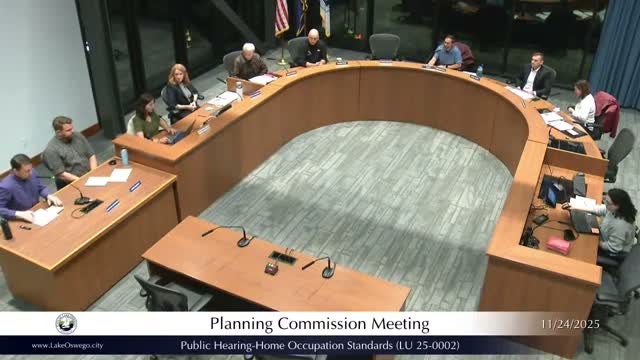
Summary
After staff recommended approval of LU25-002, the Planning Commission voted 4–1 to forward the draft to council with several items struck, to allow limited outdoor instructional activity (Option 1) and to treat urban agriculture as a conditional use so client limits can be set case by case.
The Lake Oswego Planning Commission voted 4–1 on Nov. 24 to forward the proposed home-occupation code amendments (LU25-002) to the City Council with a preliminary recommendation that strikes several staff-proposed items and treats proposed urban agriculture as a conditional use.
Staff coordinator Michael McNamee had urged a recommendation of approval, saying, “staff's recommendation is to send a recommendation of approval to the city council for these proposed amendments to the Lake Oswego Community Development Code.” The draft would replace a vague “residential character” standard with clearer, measurable rules, create three home-occupation types (A, B and C), and add limits on client counts, off-site marked commercial vehicles and hazardous substances.
The commission’s discussion focused on enforceability and unintended consequences. Code enforcement and the city’s senior code enforcement specialist, Bill Youngblood, described why staff proposed numeric limits: “We don't use decibel levels to determine illegal noise,” Youngblood said, explaining that complaint-based enforcement lacks objective thresholds and that enumerated limits help staff and judges evaluate compliance.
Small-business owners and residents offered mixed views during the hearing. Home-based business owner Sam Hall said limits could harm entrepreneurs who rely on home operations and recommended city support such as pop-up retail space. Resident Diane Cassidy, testifying separately about a related zone-change matter, urged greater citizen involvement and warned that some land-use changes could have far-reaching effects.
On specific provisions, commissioners generally supported creating the three classification types but split over numeric limits and certain proposed prohibitions. The final motion approved by the commission strikes three staff proposals (identified in the staff packet as items 3, 5 and 6), endorses Option 1 for outdoor activity (allowing small instructional classes subject to limits), and directs that the urban-agriculture use be handled through conditional-use permits so site- and operator-specific client limits can be set as part of that discretionary review. The motion was seconded and passed in a roll call vote, 4–1.
City Attorney and staff reminded commissioners that the Nov. 24 vote is a preliminary decision: the commission will adopt final written findings on Dec. 8, 2025, after which the recommendation will be forwarded to the City Council for review and a tentatively scheduled council hearing in January 2026. The commission record and future hearings will provide additional opportunities for businesses and residents to comment.
The commission’s tentative decision changes how the city would regulate home-based work and creates a path for urban-agriculture operations to be evaluated site-by-site through a conditional-use process, rather than by blanket numeric limits. The action preserves the commission’s and council’s ability to adjust thresholds before a final code change is adopted.