
U.S. and Kenya sign first "America First" global health framework, pledging $1.6 billion over five years
Get AI-powered insights, summaries, and transcripts
Subscribe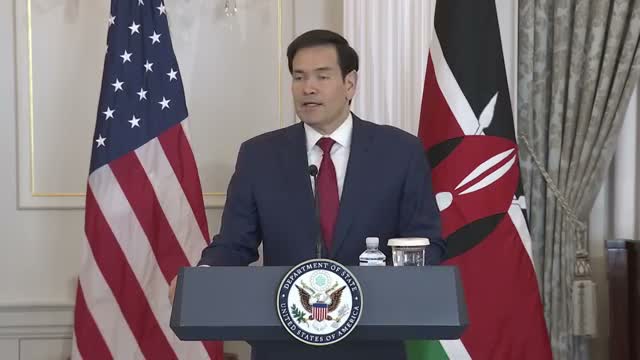
Summary
U.S. and Kenyan officials signed the first agreement under the "America First" global health strategy, with U.S. officials pledging $1.6 billion in assistance over five years and Kenyan representatives saying Kenya will contribute about $850 million and mobilize domestic resources.
Unidentified Speaker 1, a State Department official, announced the United States and Kenya have signed the first agreement under the "America First" global health strategy, with the U.S. pledging $1,600,000,000 in assistance over five years and Kenya contributing roughly $850,000,000 to the partnership.
"We are not going to spend billions of dollars funding the NGO industrial complex," Unidentified Speaker 1 said, criticizing prior aid models that channeled funds through U.S.-based non-governmental organizations and arguing the new approach will work more directly with partner countries. "If we're trying to help countries, help the country, not help the NGO to go in and find a new line of business." He added that the U.S. aims to leverage private-sector investment to build sustainable domestic systems so partner countries eventually need much less external assistance.
Unidentified Speaker 2, speaking on behalf of the Government of Kenya, called the framework "consequential, transformative, and historic," and thanked U.S. officials for the commitment. "On behalf of the government and people of Kenya, I express profound gratitude to The United States, to president, Donald Trump, and to you, Marco, for the commitment of US dollars, 1,600,000,000.0, to Kenya over the next 5 years," Unidentified Speaker 2 said. The Kenyan representative also said Kenya is mobilizing about $3,000,000,000 in domestic resources for health and has integrated 107,000 community health promoters into its health system.
Both speakers framed the agreement as a capacity-building effort aimed at strengthening Kenya’s domestic health infrastructure, improving supply chains and workforce capacity, and boosting disease surveillance and emergency preparedness. Unidentified Speaker 1 said the United States will seek to sign similar frameworks with other partner countries if the Kenya model proves successful.
The Kenyan representative reiterated Kenya’s continued regional commitments, including its role in Haiti and planned participation in a forthcoming signing on stability in the eastern Democratic Republic of the Congo. The signing event at the State Department concluded with brief closing remarks and acknowledgments; no legislative vote or congressional action was recorded in the transcript of this event.