
Oklahoma child-death review board urges safe-storage, prenatal safe-sleep education and labeling changes after cohort analysis
Get AI-powered insights, summaries, and transcripts
Subscribe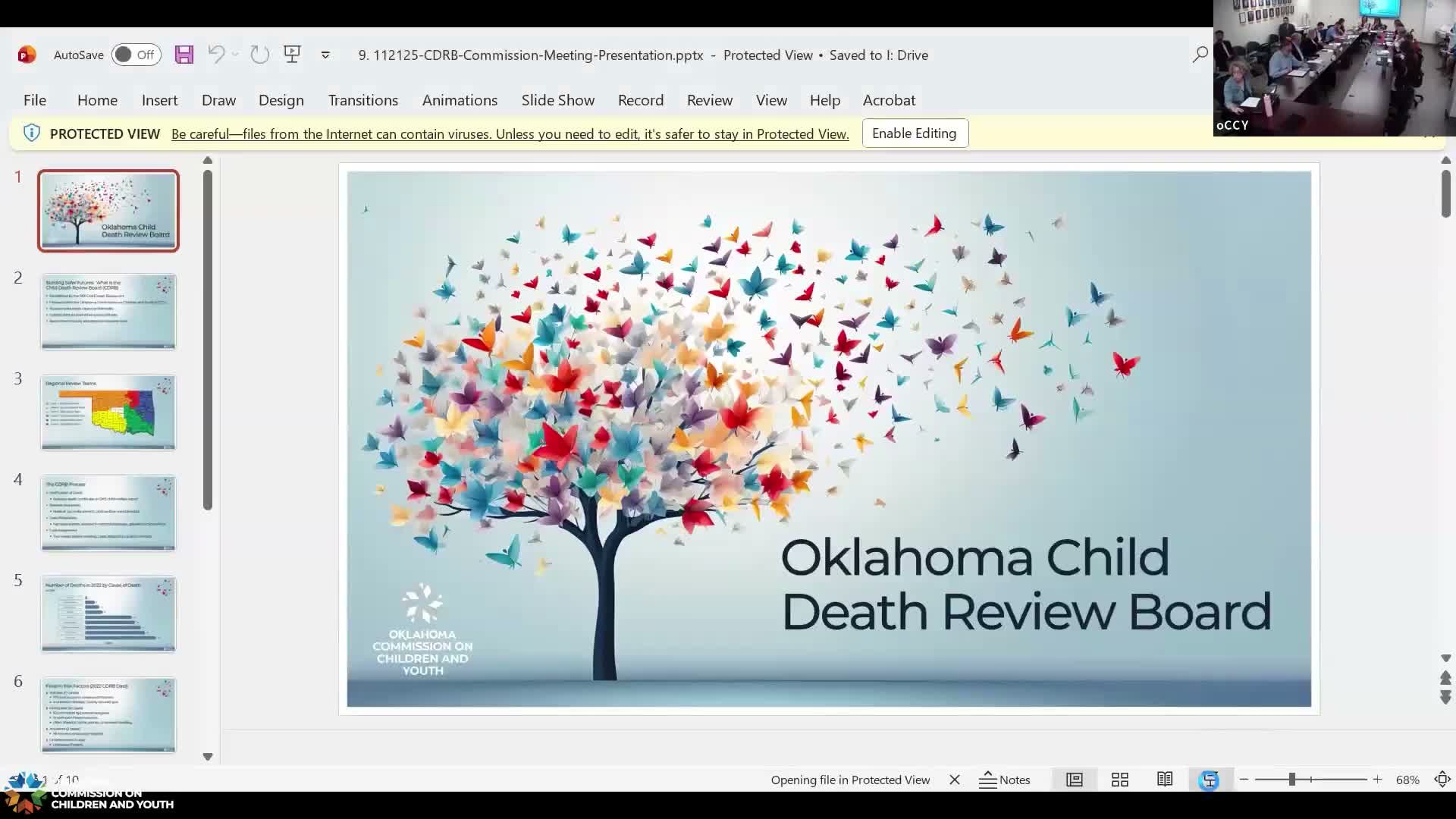
Summary
The Child Death Review Board presented cohort-year data showing high rates of preventable deaths in Oklahoma and recommended child-access prevention (safe-storage) measures, prenatal safe-sleep education, strengthened child passenger-safety laws and clearer medical-marijuana packaging to prevent THC ingestion by children.
Liz (program manager for the Child Death Review Board) told the Oklahoma Commission on Children and Youth that the boardhas completed cohort-year analyses and is making four priority recommendations to reduce child deaths and near deaths.
The board reviewed 299 child-death cases from 2022 and identified motor-vehicle crashes, unsafe-sleep environments and weapon-related injuries as leading causes. Liz said 46 deaths (15 percent) were firearm-related, including unintentional deaths in young children who accessed unsecured guns; 17 suicides (12 of them involving unsecured firearms) and 25 homicides were among the firearm cases. "It's not about politics ... it's about making it as safe as possible so we're not losing as many children as we are," she said.
On firearms, the board recommended policies and outreach to promote safe storage and cited national evidence that child-access-prevention (CAP) laws are associated with reductions in unintentional firearm deaths, suicides and homicides. Liz noted 27 states plus Washington, D.C., have implemented CAP or safe-storage laws; Oklahoma does not.
The board's second recommendation calls for beginning safe-sleep education during the prenatal period. The CDRB reported 76 cases (25 percent of its reviews) tied to the infant sleep environment; 93 percent of those deaths involved children younger than 1 year and the board characterized the majority as preventable. Liz told commissioners that teaching families about "ABC" (alone, on their back, in a crib) earlier in pregnancy could help the guidance stick before the postpartum rush of care information.
A third recommendation targets child passenger safety. CDRB data showed that of the motor-vehicle cases reviewed, 22 involved back-seat passengers and 18 of those were unrestrained. Liz said Oklahoma is the only state without a law requiring back-seat children over 8 to wear seat belts and urged the commission to support stronger seat-belt enforcement and statutory change.
Finally, the board flagged a sharp rise in near-death cases from accidental ingestion of THC edibles since medical marijuana legalization. Of 112 near-death cases in the review, 53 involved poisoning and 24 involved THC products. The CDRB proposed asking the Oklahoma Medical Marijuana Authority to require clearer, plain-language packaging and consider child-resistant, single-serve formats to reduce accidental ingestion by young children.
Liz also highlighted new capacity: two OU Hudson College graduate students and a new injury-prevention coordinator who are helping convert historical data into cohort years and build dashboards for trend analysis. The board said the recommendations will be part of its upcoming annual report and implementation strategy.
The commission heard questions from several members about rural access to safe-sleep programs, investigation completeness in suicide cases and how packaging or dosage limits for edibles might be addressed in future work.
The Child Death Review Boardpresentation concluded with commissioners thanking staff for the data improvements and noting the recommendations may inform future legislative or administrative actions.