
PSJA ISD highlights statewide reach of 'Cradle to College' conference and expands blended learning rollout
Get AI-powered insights, summaries, and transcripts
Subscribe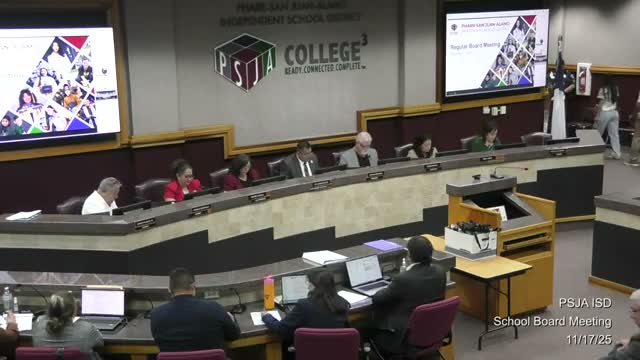
Summary
PSJA ISD officials on Nov. 17 described a recent Cradle-to-College conference that drew educators from across Texas and reported early results from a new blended‑learning initiative funded by a two‑year planning grant. District leaders said the work aims to boost graduation and dual‑credit outcomes and to personalize instruction through station‑rotation models.
PSJA ISD presented results from two district initiatives during its Nov. 17 board meeting: a Cradle‑to‑College conference that district leaders say is influencing practices across Texas, and a districtwide blended‑learning rollout funded by a two‑year planning grant.
Assistant Superintendent for Curriculum Marquez introduced the segment, and Dr. Linda Uribe said the conference drew broad participation: the district reported 277 attendees at the main conference (50 at the preconference), multiple tracks for educators, more than $9,000 in sponsorships and a net surplus of over $30,000 that the district intends to reinvest in student supports. “Our conference is opening doors for educators and even our students,” Uribe said, noting participants from Arizona, California, Indiana and Maryland and that the event is helping spread the PSJA model to other districts.
Dr. Iris Guajardo and Dr. Susana Arredondo detailed the blended‑learning initiative, which the district said is supported by a LASSO planning grant and a partnership with a technical provider (K‑12 Coalition). Guajardo described district targets and early metrics: PSJA reported a 4‑year graduation rate the district said is about 97.6% (rounded to 98%) and high participation in dual‑credit and industry certification programs. Arredondo outlined implementation specifics: elementary classrooms will run station‑rotation blended learning for 20–30 minutes daily in reading or math; middle schools will integrate blended components twice weekly, while teachers retain Tier‑1 whole‑group instruction and use adaptive technology to differentiate small‑group work.
Board members asked about sustainability after grant funding ends. Dr. Alejandro Elias and finance staff said the district will seek continued grant opportunities and internal budget support where feasible. Trustee Castillo asked whether parents might be more included in future conference strands; Dr. Uribe said parental participation is under consideration and that parent‑focused strands could be added.
The board did not take an action to adopt policy changes at the meeting; presenters recommended continued monitoring, professional development and monthly learning walks to maintain fidelity. The district said that the Texas Education Agency has expressed interest in PSJA hosting a statewide summit in fall 2026 to showcase blended‑learning practices.
The next procedural step noted at the meeting: continued implementation during the 2025–26 school year with periodic board updates and individual campus monitoring.