Get Full Government Meeting Transcripts, Videos, & Alerts Forever!
Get email alerts on the Energy Storage topic
No spam. Unsubscribe anytime.
Saline County panel approves conditional permit for battery storage site near Summit Substation after safety and insurance changes
Summary
The Saline County Planning & Zoning Commission approved CUP 25-09 for a battery energy storage facility proposed by Mountain Peak Energy Storage/Plus Power, adding negotiated insurance, grading and timing conditions after extended public safety questions and revisions to staff recommendations.
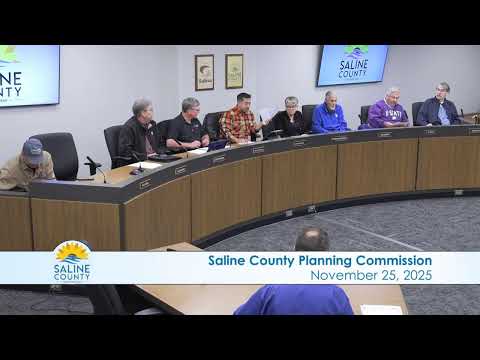
SALINA, Kan. — The Saline County Planning and Zoning Commission voted Nov. 25 to approve a conditional use permit for a battery energy storage system proposed near the Summit Substation, clearing a significant hurdle for the Mountain Peak Energy Storage/Plus Power project after several residents raised safety and liability concerns.
The permit authorizes a facility on a roughly 40-acre parcel at McReynolds and Simpson roads, with the enclosed energy storage equipment occupying less than 10 acres and site improvements totaling about 15 acres, according to the staff report and applicant presentation. Commissioners removed one staff-recommended reversion clause, agreed to a five-year construction-start window and clarified that the 25-year permit term will begin at the commencement of commercial operations. A requirement that the applicant and county negotiate an insurance amount meeting industry standards before construction was added as a condition.
Why it matters: Commissioners said the installation would sit beside a heavily used substation and could ease grid congestion and peak prices, while residents and volunteer fire officials pressed for stronger protections and clearer emergency response plans. The debate focused on whether county resources—largely volunteer fire districts—could respond to a lithium-ion battery incident, what insurance would cover, and how to monitor compliance over a multi-decade permit term.
"This technology is not new and it is not a new industry," Christina Hoffman of Plus Power said during the presentation, pointing to hundreds of utility-scale storage projects deployed nationally. Applicant representatives and outside counsel said modern systems use listed components, battery-management systems and NFPA/UL testing to reduce propagation risk compared with earlier-generation installations.
Community concerns: Local speakers raised multiple worst-case scenarios, including chemical release from thermal runaway, air and water impacts, and evacuation time for nearby schools. Johnny Keller, who identified himself as a former hazmat certifier, asked how emergency responders would contain a lithium battery fire and whether the county's water system could support an incident response. Theresa Swisher, a resident within 1.5 miles of the site, cited the EPA 'on-scene coordinator' guidance on lithium-ion incidents and said the proposed $1.5 million liability limit in the county regulations appeared inadequate.
Emergency management response: Michelle Wise, director of emergency management for Saline County, said her office had been involved earlier in the permitting process and that a draft emergency response plan had been prepared in coordination with local fire marshals and would be refined closer to construction. Wise said the county is pursuing IPAWS certification to enable polygon-based cell-phone alerts and that volunteer fire districts have limited staffing and resources.
Insurance, oversight and other conditions: Commissioners and applicants debated specific numbers for liability insurance. Applicant counsel and the company described multiple layers of protection in utility-scale projects—decommissioning financial assurances, lender requirements and insurance—while commissioners argued the county should require a higher or adjustable liability standard. The planning board ultimately added a condition requiring the insurance amount be negotiated to industry standards and agreed with the county before construction begins. The commission also:
- Removed staff language that would have forced the applicant to reapply if surrounding land use changed during the permitted pre-construction period; - Agreed the CUP's 25-year term will commence at commercial operation (applicant proposed starting the clock at operation or extending to 30 years); - Allowed grading within the defined site area necessary for foundations and stormwater, with topsoil stockpiled on-site and used for revegetation; and - Left the county's compliance-review mechanism intact, with the understanding that costs for third-party compliance reviews will be the applicant’s responsibility (the commission declined to set a fixed long-term dollar cap at the meeting).
Benefits claimed by applicant: Plus Power representatives and consulting witnesses said the project would reduce grid congestion and reduce peak wholesale costs for the Southwest Power Pool territory. Hunter Armstrong, senior project manager, said the developer proposed more than $18 million in benefits over 20 years as part of the project package. Company representatives also said the operation would yield a small number of long-term jobs (estimated 3–5 full-time positions) and short-term construction employment (12–18 months).
Vote and next steps: Commissioner (speaker 10) moved to approve CUP 25-09 with the omission of staff’s fifth bullet and with the applicant’s first four proposed conditions; the motion carried by voice vote. Staff told the public that a valid protest petition filed within 14 days could trigger a review by the Saline County Commission under state statute. The approval takes effect unless such a protest petition—meeting the statutory threshold—forces the matter to the county commission.
The commission recorded the decision on Nov. 25; construction was projected by the applicant to begin in 2029 and commercial operation in 2030, but the permit includes annual update requirements while construction remains deferred. Residents who opposed the permit said they would monitor compliance and consider an appeal.