Sedgwick County legal staff: mid-decade population review shows districts within legal tolerance; commissioners raise equity concerns
Summary
Assistant county counselor Adrienne Clark and GIS analyst Jack Joseph told the commission that mid-decade estimates put district population deviations well within the ±5% per-district tolerance under state and federal law, but a commissioner urged a future effort to address perceived geographic and socioeconomic imbalances in the map.
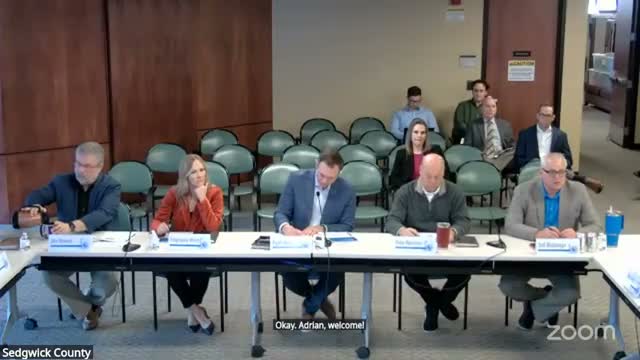
Adrienne Clark, assistant county counselor, told the Sedgwick County Board of County Commissioners on Dec. 2 that Kansas statute (KSA 19-204) requires districts be "subject to alteration at least once every 3 years," and that federal equal-protection case law permits a population deviation of up to 10% between districts (roughly ±5% per district). Jack Joseph of the county GIS office reviewed local estimates and methods the county used to assess whether redistricting is legally required now.
Jack Joseph described a methodology using 2021 adopted district totals, local appraiser data for new residential structures, GIS address points for multi-unit housing, average household size (2.54) and vacancy rates (rental ~1%, homeowner ~7%) to estimate mid-decade population. He reported an estimated county population of about 544,000 and a target per district of roughly 108,000–109,000, with the largest estimated deviation at 1.84% — well inside the ±5% threshold cited by counsel.
The presentation was framed as a statutory compliance check rather than a call to redraw maps now. "Such district shall be subject to alteration at least once every 3 years," Clark said, citing the operative statutory language under KSA 19-204. Joseph summarized the data approach and results: "the highest deviation is 1.84% from the estimated target," which he said is "well within the range of that plus or minus 5%."
Several commissioners used the discussion to press broader concerns about the county's districting history and the 2021 process. One commissioner (identified only by speaker number in the transcript) recounted the 1986 change from three to five districts and said the current map produces large disparities in land area and socioeconomic needs across districts. "It was gerrymandered and we still have a gerrymandered map today," the commissioner said, adding that the 2021 redistricting process excluded elected officials from meaningful deliberation on proposed maps.
Other commissioners and counsel noted options exist — including creating a downtown-focused district or considering six or seven districts — but advised that any wholesale changes would be better grounded in decennial census data. Counsel and staff reiterated that the mid-decade review satisfies the 3-year statutory requirement and that a formal redistricting effort is not compelled by the current estimates. The board agreed to monitor population changes and revisit the question after the next census cycle.
The commission did not take formal redistricting action at the meeting; the discussion was recorded as a legal briefing and data review required by statute and for future planning.