Get Full Government Meeting Transcripts, Videos, & Alerts Forever!
Get email alerts on the Tourism Grants topic
No spam. Unsubscribe anytime.
Moab tourism board outlines $250,000 special-events marketing grant, sets application windows and reporting rules
Summary
The Moab Tourism Advisory Board met in a Nov. 25 workshop to finalize guidelines for a newly enlarged $250,000 special events marketing grant, recommending standardized budget attachments, application windows (March 1 and a May 1–31 summer window), scoring criteria, and a preference for reimbursement-based payments to manage compliance risk.
The Moab Tourism Advisory Board reviewed and revised guidelines on Nov. 25 for a $250,000 special events marketing grant intended to draw larger and shoulder‑season events to Grand County.
At a workshop that included staff and community stakeholders, members said the program — enlarged from roughly $220,000 in earlier budgets — should prioritize projects that demonstrably increase overnight stays and bring measurable economic benefit. The board discussed required attachments (a line‑item marketing spreadsheet), six scoring criteria, application windows and whether to pay grants up front or by reimbursement.
The scoring criteria the board agreed to refine include: the quality of the proposed marketing strategy; potential to increase overnight stays and evidence of lodging partnerships; expected revenue and local economic impact; emphasis on shoulder‑season visitation; how crucial the grant is to the event’s success; and community support or involvement. Board members suggested a 1–5 scoring scale and asked staff to add application questions that make community support and lodging partnerships explicit.
Members debated program design features aimed at attracting larger or new events. Ideas discussed included a tiered approach (for example, smaller $10,000 awards and larger $50,000–$100,000 awards) and temporarily more generous matching for first‑time events (suggested examples included 60/40 rather than 50/50) to reduce startup risk. No formal rule change was adopted; the board asked staff to draft clear language and return a revised application for approval at the Dec. 9 meeting.
The group also set intake timing and windows for the program’s first cycle. The committee recommended a March 1 application deadline for the initial round (covering an initial Jan.–Dec. funding window, with limited retroactive reimbursement allowed for events earlier in the start‑up cycle). A second summer window would open May 1 and close May 31 for grants covering events July 1–June 30. Going forward, the board proposed opening full‑year applications Nov. 1 with a Nov. 30 close so future cycles align to a calendar schedule.
A prolonged discussion focused on disbursement and compliance. Several members urged a reimbursement‑first model to reduce administrative risk and the need to claw back funds when event organizers fail to deliver complete documentation. Others advocated partial upfront payments to help organizers with cash flow. Concerns about trust, past unaccounted funds, and staff capacity to monitor and enforce contracts led the board to lean toward reimbursement for the first cycle while leaving room for case‑by‑case adjustments.
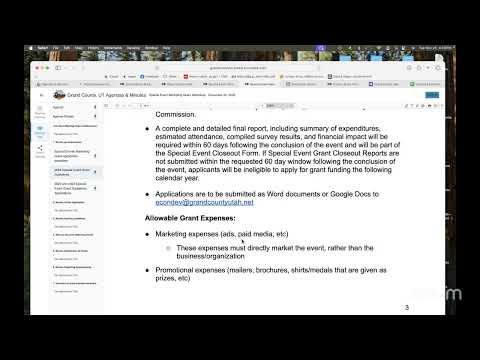
Reporting and closeout requirements were clarified: applicants will be required to submit final closeout reports, including an itemized final budget spreadsheet, invoices/receipts, proof of payment and counts of participants and lodging impacts. The board discussed using event surveys but agreed to make detailed survey requirements a follow‑up item for the mid‑year review.
Members emphasized eligibility and purpose: grants should primarily promote events that drive visitation to Grand County rather than solely advertise private businesses, though exceptions for conferences or corporate events that demonstrably generate room nights were discussed. The board agreed to require applicants to demonstrate intent (an intent‑to‑apply statement) and to show necessary permits and approvals from relevant public land managers and local jurisdictions as part of a complete application.
Operational questions remained. Members raised the need for a dedicated administrator or events coordinator to manage intake, compliance and final reporting. The board proposed subcommittees to review preliminary applications and recommended rotating membership to avoid reviewer burnout. Staff (Speaker 5) said she would revise the application and scoring rubric and circulate it for comment before the Dec. 9 meeting, at which the board will seek approval to release the application publicly.
"We were not voting today — it's just a workshop," one participant (Speaker 5) said, reflecting that the meeting was intended to shape the application rather than finalize policy. The board adjourned after confirming next steps: staff will update the application text, prepare the standardized budget spreadsheet template, invite outside partners (marketing vendors) to the Dec. 9 meeting, and return recommended language for funding, matching and reporting.