
Hubbardston keeps single FY2026 tax rate; residential factor set at 1
Get AI-powered insights, summaries, and transcripts
Subscribe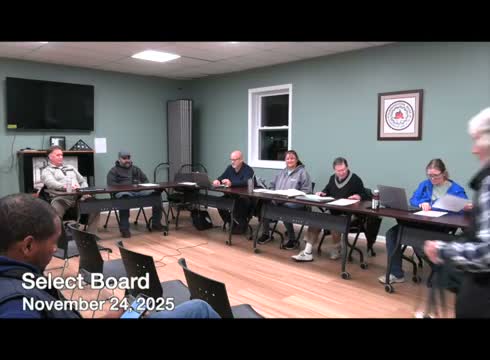
Summary
After a joint hearing with assessors, the Select Board voted to set the residential factor at 1 and keep a single FY2026 tax rate (reported at about $11.11), following the Board of Assessors’ recommendation and a presentation from RRG Associates.
The Town of Hubbardston Select Board on Nov. 24 voted to adopt the Board of Assessors’ recommendation to keep a single FY2026 tax rate and to set the residential factor at 1.
Steven Boucher of RRG Associates, the town’s contracted assessor, presented the levy calculations and valuation breakdowns and said roughly 92.6% of the town’s taxable value is residential. Boucher reported new growth of about $78,823 and described a Department of Revenue levy ceiling computed as 2.5% of the town’s taxable value; he showed two scenarios in the packet: a split rate (residential ~$10.75, commercial/industrial/personal property/chapter land ~$15.67) and a single rate that factors to about $11.11. Boucher told the board that rising valuations can lower the tax rate while still raising homeowners’ bills and that the packet did not yet reflect three recently approved exclusions because those figures had not been loaded into the state site.
“ Our goal here isn’t to make money for the town. Our goal is to pay the bills, ” Boucher said when explaining the rationale for the assessors’ recommendation.
The chair read a motion citing Massachusetts General Laws Chapter 40, Section 56, to set the percentage of the town tax levy by class and to set the residential factor at 1. A motion and second were recorded and the board conducted a roll-call vote: Peter — yes; Kaylee — yes; Heather — yes; Chris — yes; Jeff — yes. The motion passed.
Boucher’s packet included an illustrative average valuation of about $442,500 and projected an average tax increase of roughly $162, bringing the illustrative average annual tax to about $4,916. Board members and Boucher cautioned that some numbers in the meeting packet contained minor typographical inconsistencies and that the three newly voted exclusions were not yet reflected in the state-site projection, so final taxpayer impacts could change after the Department of Revenue processes the update.
The Select Board recessed the hearing after the vote and proceeded to other agenda business.