Get Full Government Meeting Transcripts, Videos, & Alerts Forever!
Get email alerts on the ESA Eligibility topic
No spam. Unsubscribe anytime.
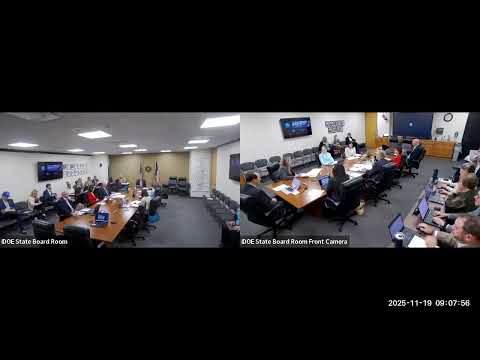
Iowa State Board upholds administrative judge in ESA eligibility appeal after parent cites conflicting guidance
Summary
The State Board of Education voted to affirm an administrative law judge27s decision denying an Education Savings Account payment after an appellant said she relied on repeated incorrect guidance from the program administrator; board members cited statutory timing requirements as dispositive.
The Iowa State Board of Education on a recorded vote affirmed an administrative law judge27s ruling that a student did not retain eligibility for Education Savings Account (ESA) payments because the student was not enrolled full time at a nonpublic school on or before the statutory Sept. 30 deadline.
Sarah Fernandez, who appealed the department27s denial, told the board she repeatedly received incorrect information from Odyssey, the ESA third-party administrator, and that she relied on those assurances when transferring her child to a private school after the Sept. 30 cut-off. Fernandez said the provider27s staff told her the transfer and payments would be permitted, and she asked the board to refund tuition she incurred as a result of those representations.
"I was given wrong information," Fernandez said, describing multiple conversations over several months in which Odyssey staff reassured her that funds would still be available. She argued the misstatements led her to transfer her child and incur costs that she would not have incurred had she been told the deadline was absolute.
Assistant Attorney General Lindsay Browning, arguing for the department, acknowledged the appellant27s advocacy but told the board the record and the governing law required enrollment in a nonpublic, full-time program on or before Sept. 30. "It is a fundamental statutory requirement," Browning said, and the board must afford deference to the administrative law judge27s factual findings.
General counsel Thomas Mays explained the procedure for the contested-case hearing and clarified timing and time limits for oral argument. Board discussion focused on whether the board had discretion to override the statute in cases involving misinformation. Multiple members expressed sympathy for Fernandez but cited the statute and administrative rules as limiting any relief. One board member said the department27s review ultimately identified the timing issue.
Board members then moved and seconded a motion to support the ALJ27s proposed decision in Sarah Fernandez v. Iowa Department of Education (Case no. 25 DOE 308). The motion carried.
The board did not order reimbursement or any other make-whole remedy. Several board members suggested the department should review communication processes with Odyssey and consider steps to prevent similar confusion going forward.
What's next: The board recorded its affirming decision; Ms. Fernandez and department counsel were excused after the action. The decision stands unless further judicial review is pursued.