
Ipswich River group urges conservation and regional cooperation as drought squeezes supplies
Get AI-powered insights, summaries, and transcripts
Subscribe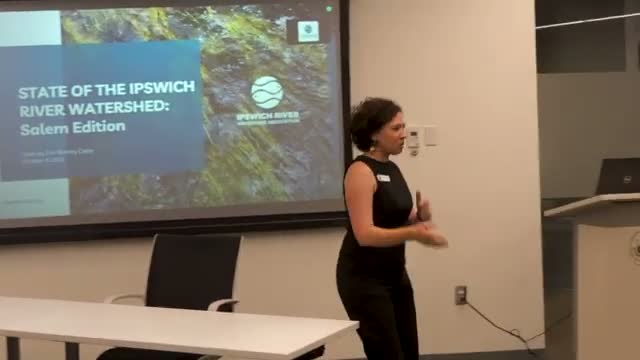
Summary
At a Salem committee meeting, the Ipswich River Watershed Association warned that repeated low-flow years threaten the river and presented three response paths — connecting to MWRA, expanding local storage and aggressive conservation — while Mayor Dominic Candalo said Salem’s reservoirs are about 71% full and water is not the sole obstacle to planned housing growth.
Salem’s Climate, Energy and Resiliency Committee on Tuesday heard a detailed presentation from the Ipswich River Watershed Association on drought, regional water-supply options and conservation measures as communities across the basin face increasingly frequent low flows.
"The number 1 issue that, threatens the health of the Ipswich River is this question of supplies," said Erin, executive director of the Ipswich River Watershed Association, in a presentation that documented record low flows in 2016, 2020, 2022 and 2024 and showed before-and-after drought photos. She told the committee the river and its watershed act as a regional barometer: what happens upstream affects downstream towns and drinking-water reliability.
Mayor Dominic Candalo, who opened the meeting, said Salem’s reservoirs provide a buffer. "We're about 71% of our capacity in the reservoirs," he said, adding that current storage helps ensure "a reliable and consistent water supply for our community." The mayor also referenced a recent Mass Inc. report estimating the need for roughly 2,200 new housing units over the next decade and said water supply "is not a barrier to housing growth in our community."
Erin outlined three broad options under review by the North Shore Water Resilience Task Force. The first would import treated water from the Massachusetts Water Resources Authority (MWRA) by pipeline; her presentation cited a previously circulated estimate of roughly $1.5 billion to run dedicated pipelines to many towns, with lower-cost, targeted scenarios (for example connecting only the highest-demand towns) estimated near $150 million.
Option two would rely on in-basin storage and operational changes. Erin said the Salem–Beverly Water Supply Board already uses reservoirs such as Putnamville Reservoir and Wenham Lake to "season" water before treatment and that one available site in Topsfield could be developed as additional winter storage, though she noted significant infrastructure and cost constraints.
Her preferred third option focused on conservation and demand management: community-level conservation plans, seasonal or tiered pricing and measures to reduce lawn irrigation and other discretionary uses. Erin cited benchmarks used in the region — the state’s residential guideline of about 65 gallons per capita per day, versus a suggested sustainable target of about 40 gallons per person per day for the watershed — and said Salem’s current average is roughly 45 gallons per person per day.
The presenter stressed regional coordination: roughly 350,000 people live in areas that draw from the Ipswich basin, she said, and upstream withdrawals can leave downstream communities with very low flows. Erin also described regulatory and planning tools that intersect with those choices, including municipal MS4 stormwater permits that govern runoff controls and stormwater management.
On advocacy, Erin said watershed groups are supporting a state-level Drought Bill to standardize stricter, drought-triggered conservation rules in water-withdrawal permits, and are participating in a ballot initiative called "Nature for Massachusetts" aimed at directing sales-tax revenue toward land and water conservation; organizers plan to collect signatures ahead of a November 2026 vote.
Committee members asked technical questions about water chemistry, system leakage and metering. Erin said reservoir storage can improve source water quality by providing a seasoning effect but that summer low flows tend to worsen in-stream water quality. She estimated unaccounted or "nonrevenue" water in the Salem–Beverly system at roughly 25–30 percent and noted that many renters lack direct access to water bills, which limits household incentives to conserve.
The meeting closed with no formal votes or binding decisions. Chair John thanked Salem Access TV for recording the session and reminded attendees that CERC meets monthly on the fourth Wednesday.