
Westford schools report dip in MCAS performance; district cites writing and pandemic cohorts
Summary
The Westford School Committee reviewed four-year MCAS data showing declines in some high-school metrics and writing scores. District leaders said cohort effects from COVID and lost intervention staff likely contributed and outlined curriculum and screening steps to address gaps.
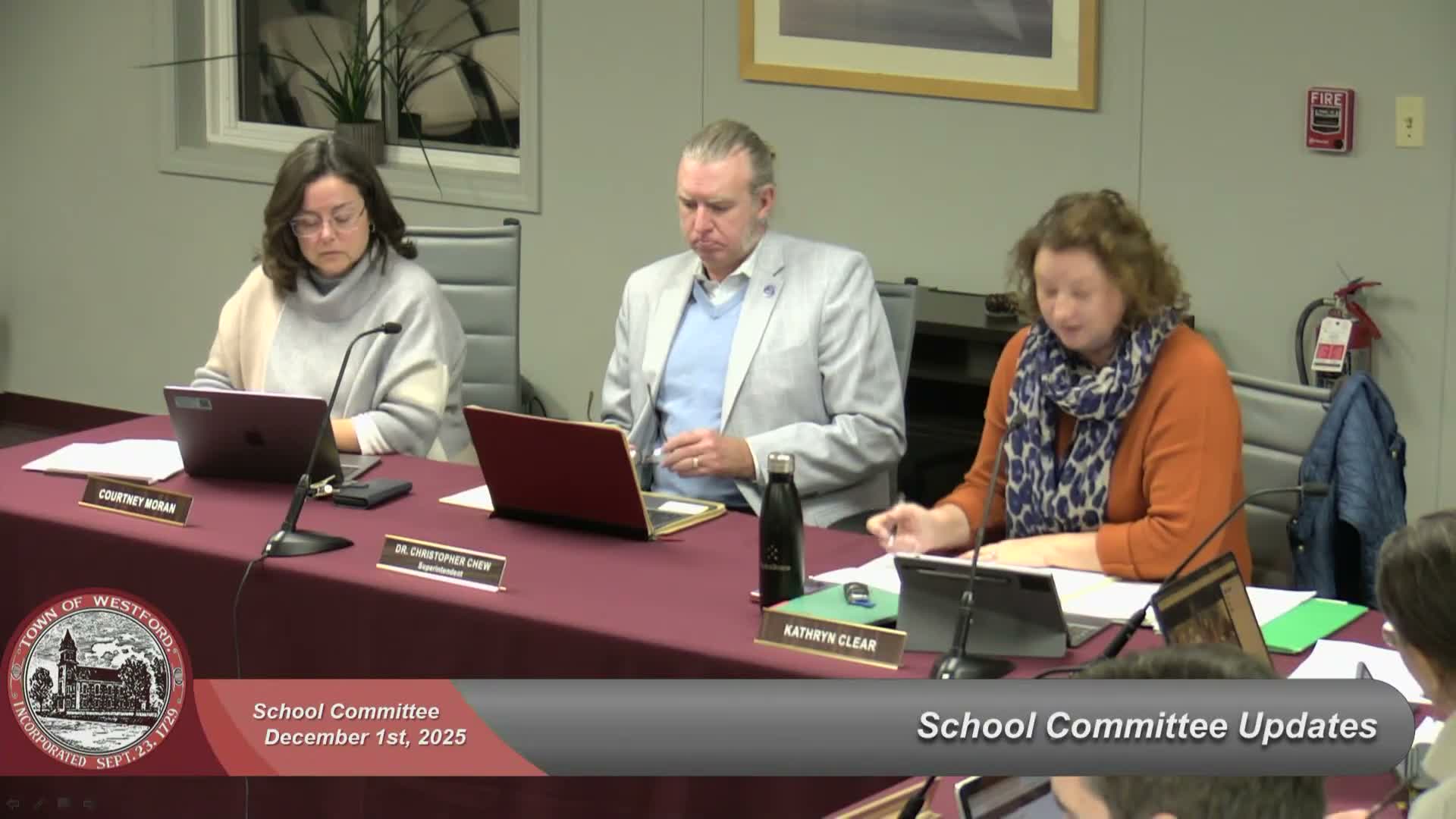
Courtney, the district's MCAS presenter, told the Westford School Committee on Dec. 1 that grade-10 results show a four-year drop in the share of students meeting or exceeding expectations — from the mid-80s in earlier years to about 78% in the most recent report. "We did have a dip in 78% of exceeding and meeting standards this year, opposed to the last 3 years where we were looking at 84%, 87%, 88%, and now we've dipped down to a 78%," Courtney said during the presentation.
The presentation highlighted consistent strengths in English language arts (grammar, essay structure) and in math areas such as geometry and algebraic reasoning, while noting weaknesses in essay performance, data and probability standards, and elementary-level foundational reading for some cohorts. Erin, who oversees foundational reading implementation, said the district's UFLI program and EL curriculum are designed to improve writing and reading outcomes but that it typically takes three to five years for curriculum changes to show in standardized testing. "When we implemented that it takes about 3 to 5 years for us to see it generalized to standardized testing," Erin said.
Committee members pressed staff on whether recent budget-driven staff reductions — notably fewer interventionists and support personnel in lower elementary grades — could be linked to the declines. One committee member said cuts to reading and math intervention staff over the last three or four budget cycles could be a contributing factor. Courtney and other staff emphasized the district's multi-tiered system of supports (MTSS), diagnostic screeners (DIBELS, iReady), and targeted professional development as the primary levers to address gaps. Courtney said the district is comparing MCAS results with internal screeners to ensure interventions are aligned.
The presentation also noted pending state-level changes: Courtney said a new framework released by the Healey administration may phase out MCAS at the grade-10 level and introduce end-of-course assessments in coming years. Staff urged caution: any state redesign will be vetted and could require the district to change local graduation-competency language.
The committee concluded the item by asking staff for more school-level and subgroup drilldowns — especially for students with disabilities, English learners and high-needs cohorts — and for a look at internal writing assessments that could better track progress between MCAS cycles. The district committed to follow-up data in subsequent meetings.

Create a free account
Unlock AI insights & topic search