CWCB closes record after daylong, heated debate over proposed Shoshone in‑stream flow deal; co‑management remains central dispute
Loading...
Summary
After a marathon contested hearing, the Colorado Water Conservation Board closed the administrative record on a proposed perpetual in‑stream flow interest in the Shoshone water rights. The River District and CWCB staff submitted a revised co‑management agreement; Front Range water providers urged the board to retain final authority over any call reductions. Deliberations continue.
Denver — The Colorado Water Conservation Board (CWCB) closed the administrative record Friday after more than a day of presentations, public comment and negotiations over whether the state should accept a perpetual interest in the Shoshone water rights to protect flows in the Colorado River.
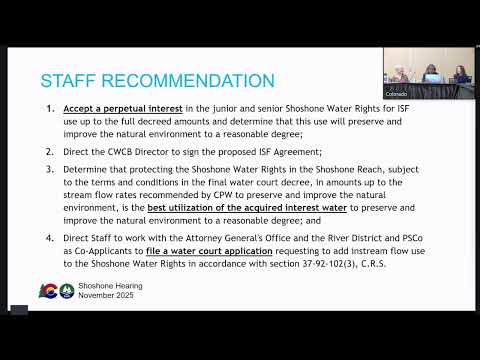
CWCB staff and the Colorado River Water Conservation District presented a revised in‑stream flow (ISF) agreement they say addresses the board’s directives from a September hearing. The deal would accept a permanent, state‑held interest in the senior and junior Shoshone water rights and set out a co‑management process in which the river district and CWCB staff would jointly evaluate requests to relax the Shoshone call in narrowly defined circumstances.
“This is a once‑in‑a‑lifetime chance for the state of Colorado,” Rep. Julie McCluskey told the board during public comment, urging directors to adopt staff’s recommendation and move to water court. “It will safeguard historic flows in the Colorado River and establish a durable partnership between the state and the Western Slope.”
Why the deal remains contested
The central disagreement that kept the hearing contested was governance: whether the CWCB should retain ultimate authority to allow any voluntary reductions of the Shoshone call, or whether the river district should have a continuing, binding role in those decisions. The River District argued that co‑management is essential to guarantee Western Slope interests and to make the donation politically and practically viable; several Western Slope counties and water users said they would withdraw financial support without it.
“You are being asked to accept terms that, by design, give the River District a continuing, meaningful role in deciding whether a call is relaxed,” said Jessica Brody, Denver Water’s general counsel. “Because the legislature gave this board the exclusive authority to appropriate and control in‑stream flow water rights, the board must retain final authority over those decisions.”
River District General Manager Andy Mueller said the proposed shared process preserves the board’s role while ensuring the West Slope — which is donating the rights and will be directly affected by operations — has a permanent seat at the table. “We are asking for a collaborative protocol that allows statewide input and, in limited, extreme circumstances, a narrowly defined discretionary reduction by the CWCB,” Mueller said.
Key procedural developments
• Appointment of a hearing officer and re‑opening of the administrative record: The board appointed a new hearing officer and re‑opened the record in October while parties worked toward a stipulation. (Board action: appointment and reopening recorded on the transcript.)
• Revised ISF agreement: Following mediation facilitated by the Colorado Forum, CWCB staff and the River District posted a redline that clarified responsibilities, added a mandatory “2007 call‑relaxation” provision applicable under the narrow criteria in that earlier agreement, and set out a collaborative voluntary‑reduction process. The revised text also states the River District will pay for any measurement infrastructure reasonably required by the state engineer.
• Front Range counterproposal: Denver Water, Northern Water and municipal utilities proposed alternative language maintaining the CWCB as the final decision‑maker if consensus cannot be reached. They argued the board’s statutory duty and fiduciary role preclude ceding that authority to another public entity.
What’s next
At the end of the session the board voted to close the administrative record; formal deliberations and a final board decision were deferred to the board’s next session. If the board accepts staff’s recommendation, CWCB staff said they will file a water‑court change‑of‑use application with the Attorney General’s Office and the River District as co‑applicants; the court will then adjudicate the water right change, including historic consumptive‑use calculations and terms and conditions necessary to prevent injury.
Several board members expressed support for the acquisition in public deliberations, while urging continued negotiation in water court to resolve remaining uncertainties about administration and measurement. Director Dan Gibbs, representing the Department of Natural Resources, said the deal “represents a once‑in‑a‑lifetime opportunity” to protect the river’s ecosystem and committed agency staff to work through technical issues in water court.
Key quotes
• “This is a once‑in‑a‑lifetime chance for the state of Colorado,” Rep. Julie McCluskey said during public comment.
• “We want a collaborative process, but the board should retain the final say,” Jessica Brody, counsel for Denver Water, said.
• “We are committed to joint management in a way that protects the West Slope,” Andy Mueller, general manager of the Colorado River District, said during the staff presentation.
Outlook
The board’s vote to close the administrative record begins the transition to water‑court review and the next round of technical and legal negotiations. The outcome of water court will determine precise historic use and any terms placed on the ISF decree; the board’s decision on whether to accept the River District offer will determine whether the state moves forward as a co‑applicant on that court case.