
Clear Creek Amana board opens discussion on a shared school resource officer with city
Get AI-powered insights, summaries, and transcripts
Subscribe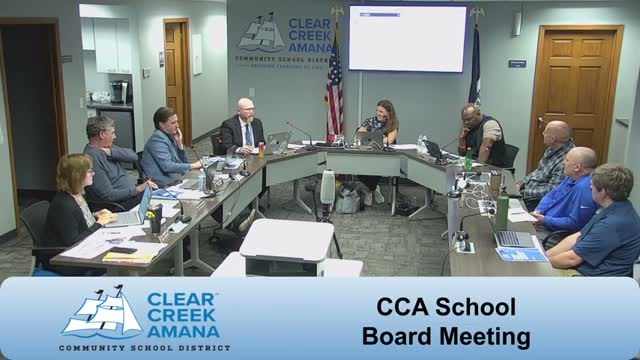
Summary
Superintendent proposed exploring a shared SRO for middle and high schools, funded with categorical 'at‑risk' dollars and a proposed 75% district / 25% city cost split; board requested more data on duties, time allocation and jurisdictional implications and expects a decision in January.
The Clear Creek Amana board spent substantial time discussing whether to pursue a shared School Resource Officer (SRO) for the district’s secondary buildings and what a partnership with the city might look like.
Superintendent Mr. Davidson said the district could use categorical at‑risk funds to cover most of the cost and that the city of Tiffin has indicated willingness to contribute. "We would be looking at paying 75 percent; we'd ask the city for 25 percent," he said, describing a model that would start with a shared officer covering the middle and high schools during school days and available to the city at other times under contract.
Board members raised a series of questions. They asked for: clear job and day‑to‑day duty descriptions for any SRO; the process for selecting and approving the individual; data on existing law‑enforcement contacts on campus; how county boundaries and multi‑county attendance centers would affect deployment; and the likely time allocation between school duties and city policing responsibilities.
A board member summarized a central concern plainly: "This would be a fully uniformed officer with a gun on our campuses," and asked administrators to weigh the potential impact on students who have prior negative experiences with law enforcement.
Supporters said they were open to more information; one board member urged caution but noted recent tragedies elsewhere have shifted the conversation about proactive safety. Several members asked the superintendent to gather comparative data from nearby districts and detailed campus call logs so the board can judge both public‑safety benefits and social/emotional effects on students.
Next steps and timeline: Mr. Davidson said he will solicit staff and principal input, gather comparative data from other districts and city partners, and present a data package for board consideration — aiming for a decision at the board’s January meeting so the city can plan budgetarily if the board chooses to partner.
Outcome: No vote was taken. The board directed administration to collect information and return with a formal recommendation.