Get Full Government Meeting Transcripts, Videos, & Alerts Forever!
Get email alerts on the Utility Rates topic
No spam. Unsubscribe anytime.
Kalamazoo utility staff propose modest water and wastewater rate increases to fund $1B in capital work
Summary
City utilities staff recommended multi-year rate increases (water ~5% overall; wastewater ~9% this year) to finance a $770M water and $240M wastewater capital program, including lead service-line replacements, water‑main renewals and a planned biosolids project; the water ordinance is set for first reading tonight.
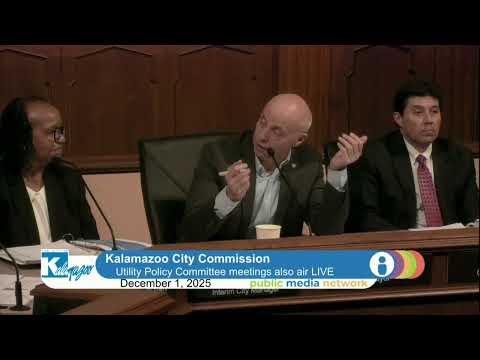
Kalamazoo utility officials proposed a package of rate changes and capital investments at the Committee of the Whole meeting on Dec. 1, saying modest customer increases are needed to fund multi‑year repairs and upgrades across water and wastewater systems.
Director Baker told commissioners the five‑year capital program includes roughly $770,000,000 for drinking water work and about $240,000,000 for wastewater improvements. "Our water system provides retail water service to an area of about 190,000 people," he said, adding that City of Kalamazoo residents make up about 40% of that service area. Baker said the utility now operates 13 drinking‑water treatment plants — one of the largest all‑groundwater systems in Michigan — and a single wastewater reclamation plant that treats roughly 27,000,000 gallons per day.
Why rates: the presentation tied proposed increases to predictable needs: lead service‑line replacements, cast‑iron main replacements, water‑quality improvements (including iron removal) and system reliability upgrades. Baker said the city started an accelerated lead‑service program in 2017 and is about 61% complete, with roughly 10,000 services remaining and 1,200 replacements planned in the Edison neighborhood in 2026. "We started replacing lead service lines at 500 services or more per year, with a goal of completing all that work by 2037," he said, and added the city expects to be about 75% complete next year if planned work proceeds.
Baker reported steady water‑quality progress: the utility’s 90th‑percentile lead result is about 3 parts per billion after the action level was lowered from 15 to 12 ppb. He described a mix of measures — service‑line replacement, optimized corrosion control and plant consolidation — that together are driving the improvement.
Rate proposal and customer impact: staff said a cost‑of‑service analysis supports a ~5% overall water rate increase with class‑specific changes (residential ~6.5%, multifamily ~3%, commercial/institutional ~5%). Wastewater was recommended for a ~9% increase this year, with the city estimating a typical city customer could see about $2.38/month for water and $2.69/month for wastewater — roughly a $5/month combined increase (billed quarterly, those figures translate to about $15 per quarter). Baker framed several years of phased, programmatic increases in the packet: "in water, we're looking at a 5 to 7% structural increase every year," he said, noting the utility forecasts a potential rate holiday in 2031 if a biosolids project delivers the projected savings.
Projects and risks: Baker described recently completed and planned projects, including a $26,000,000 tertiary disc‑filter building at the wastewater plant and work to reduce odors (an 89% reduction in hydrogen sulfide around the plant). He also explained the utility’s approach to water‑main prioritization — a probability‑of‑failure index used to coordinate replacements with street projects — and discussed evaluations of biosolids alternatives after a state funding application was not awarded.
Operational measures: staff outlined a proposed leak‑adjustment policy on the consent agenda that would be triggered if a customer’s consumption is 50% greater than prior consumption; customers would apply, show the leak was fixed and pay their average bill rather than the exceptional amount. Baker emphasized meter‑replacement and smart‑meter work that would be required to move the billing system to monthly reads; full system conversion is estimated to be several years away unless larger capital investment is approved.
Process and next steps: Tom Wheat of the Utility Policy Committee said the UPC unanimously supported staff recommendations. Baker told commissioners the water‑rate ordinance is scheduled as a first reading on tonight's regular agenda; wastewater rates will come forward as a resolution on Dec. 15. If approved, staff said the proposed rates would be effective Jan. 1 to align with the 2026 budget.
Commissioners asked about customer protections and affordability supports; staff pointed to a leak‑adjustment policy, existing assistance programs and Community Action partnerships that Baker said are promoted on bills and via the city website. No formal vote was taken during the work session portion; the ordinance/resolution process will follow the normal agenda calendar.