
Wayne County board discusses Tethr electronic monitoring, jail space and contract compliance
Get AI-powered insights, summaries, and transcripts
Subscribe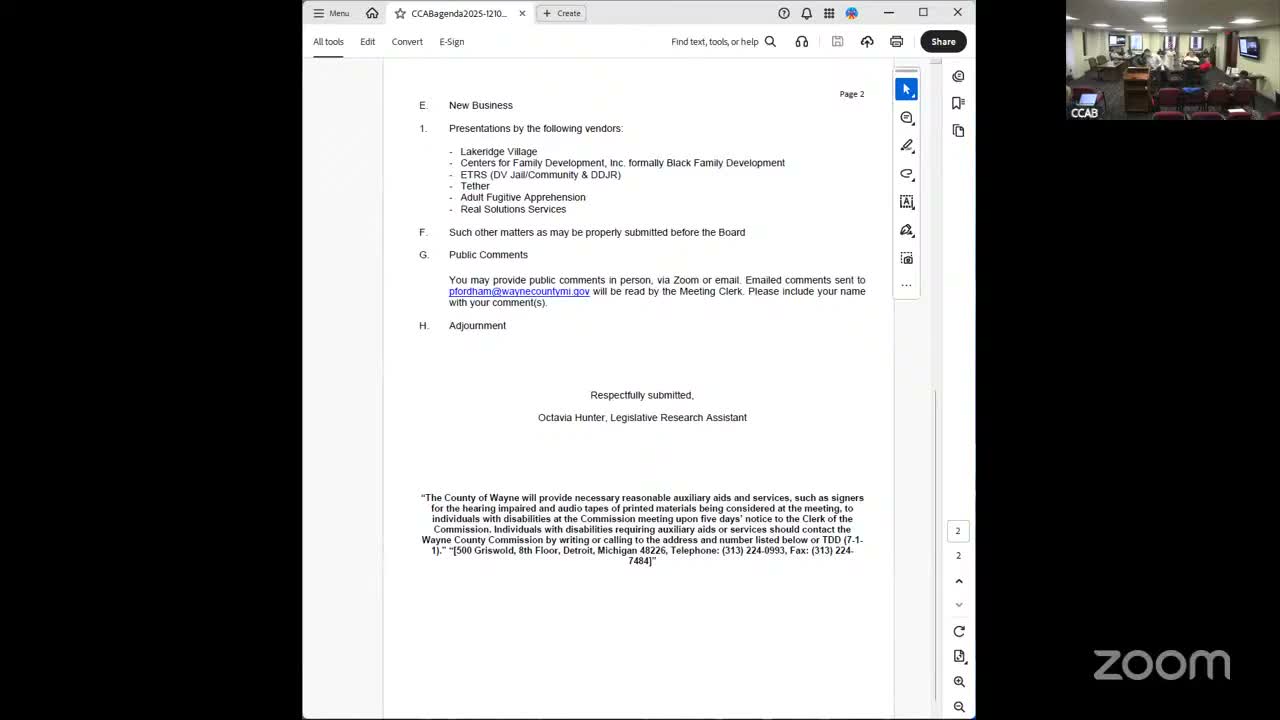
Summary
Board members and staff discussed the county's Tethr electronic-monitoring program (about 1,100 people on tether), PA 5 11 funding rules, MDOC documentation requirements and jail classroom space that limits contracted group and individual sessions; the board pledged operational follow-up but took no formal action due to lack of quorum.
When the Wayne County Community Corrections Advisory Board moved from vendor presentations to operational matters, members focused on the county's electronic monitoring (Tethr) program and on jail facilities and contract compliance.
Chief Robert Dunlap described Tethr as an alternative to incarceration that allows participants to participate in community-based treatment while remaining under sheriff's office supervision. "I believe we're somewhere we're still in a neighborhood of about 1,100 people on Tethr," he said. County staff and sergeants clarified that the majority of Tethr placements are pretrial but that a small percentage are post-conviction; Chief Dunlap estimated post-conviction placements are likely under 4%.
Board members asked practical questions about the technology and program administration. When asked whether Tethr devices continue to function during power outages, staff replied yes. The board also discussed the program's funding under PA 5 11 and accounting for which enrollments are billable to community corrections.
Contract manager Lucille Battle raised a separate but related operational issue: inadequate space in the jail's classroom for required group and one-on-one sessions under vendor contracts. "That space is too small," Battle told the board, describing crowded conditions when groups reach the contract maximum of 15 people and explaining that 90-minute group sessions leave no practical time for contracted individual sessions. She said auditors must verify that both group and individual services in the contract are being provided and that scheduling and space problems complicate compliance.
Chief Dunlap acknowledged the constraints and proposed a meeting with jail operations staff to identify larger spaces (for example, the gym or a program pod) and to explore funding for officers to support expanded class schedules. Board staff also raised that the Michigan Department of Corrections is pushing evidence-based practices and that PA 5 11 funding may require a recorded risk-assessment in tether files; members agreed administrative follow-up is necessary to add risk-assessments if required.
No formal votes or funding decisions were made because the board did not have a quorum. Board members asked staff to convene meetings with jail operations, community corrections auditors and vendors to resolve space, scheduling and documentation issues and to report back at a future meeting.