
Human Services Committee asks state's attorney to flag county code inconsistencies
Get AI-powered insights, summaries, and transcripts
Subscribe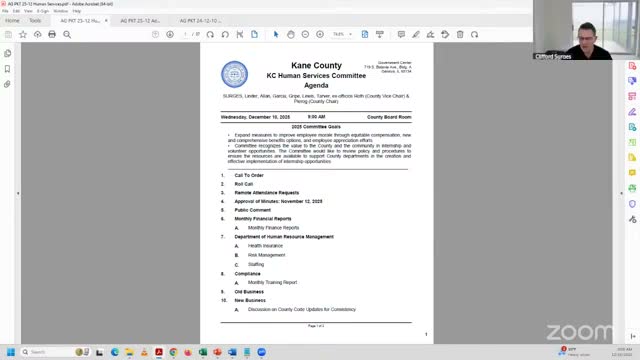
Summary
Committee member Mister Surgis asked the Kane County Human Services Committee to have the state's attorney review county code inconsistencies and return a prioritized list of recommended corrections; staff and the state's attorney agreed to coordinate and report back, with no formal vote required.
Vice Chair Michael Litter presided over a Kane County Human Services Committee meeting where members agreed by consensus to ask the state's attorney to review and flag inconsistencies in the county code and return recommendations to the committee.
Mister Surgis opened the discussion, saying the county has long-standing inconsistencies and conflicts in its code that range from obscure provisions to direct conflicts between boards. "We should probably do an evaluation and dive in to say, okay — are we talking about three things or are we talking about 300 items that may be in conflict," he said, urging the committee to set realistic expectations about the project's scope.
Jamie Libero, staff, said the state's attorney raised similar concerns while the committee considered a recent ordinance and that the state's attorney already has a preliminary sense of problematic sections. Ken Chaprow of the state's attorney's office told the committee the office would review the code, identify inconsistent sections and either propose deletions or recommend consolidating scattered references into a single, clearer section.
Committee members discussed project scope and timing; members cautioned a comprehensive redo could be a lengthy, year-long effort involving multiple committees, while a focused review of identified items could be completed more quickly. Libero offered to work with the state's attorney to facilitate the review and present a prioritized list back to the committee for its direction. Litter asked whether any formal action was needed; Libero responded no formal action was required and that staff would proceed at the committee's direction.
The committee did not adopt ordinances or make code changes at the meeting; it directed staff and the state's attorney to identify, prioritize and return with recommended edits and a suggested path forward.
The next step is for Libero and the state's attorney to compile the flagged items and present them to the committee for prioritization and potential drafting of resolutions or ordinances.