
Downtown Missoula Partnership marks 50 years as businesses and community stress resilience
Get AI-powered insights, summaries, and transcripts
Subscribe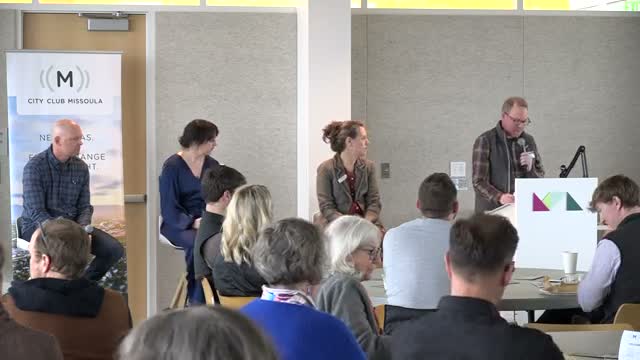
Summary
At a City Club Missoula December forum, leaders from the Downtown Missoula Partnership celebrated five decades of downtown programming and investment, and Big Dipper founder Charlie Beaton reflected on three decades of small-business growth and challenges for new entrepreneurs.
City Club Missoula hosted a December forum spotlighting downtown successes and the challenges facing small businesses, where Downtown Missoula Partnership leaders and Big Dipper founder Charlie Beaton recounted decades of growth and urged community support for local entrepreneurs.
Kristen Sackett, marketing and events director for the Downtown Missoula Partnership, charted the Partnership's evolution from a 1975 merchants association into a coalition of the Missoula Downtown Association, the Downtown Business Improvement District and the Missoula Downtown Foundation. "As downtown goes, the rest of your community goes," Sackett said, arguing that events and place-making keep downtown vibrant. She cited long-running events such as Out to Lunch (started in 1986) and said the Partnership's foundation has "raised and then reinvested more than $3,500,000 back into the downtown." Sackett also provided program figures: "The downtown gift card program annually sells over $520,000 a year in gift cards with the redemptions going back into businesses about $450,000," which she described as circulating money locally.
Charlie Beaton, who founded Big Dipper in 1995, told the audience that collaboration and neighborhood ties helped his business grow from a single shop at 5th and Higgins into a regional brand with additional retail locations, a mobile "Cone Boy" truck and franchises. "The key to the success of Big Dipper, I'd say, is the people," Beaton said, naming employees with 17- and 25-year tenures and describing partnerships with local chefs and early social-media engagement as turning points.
The panel and audience spent the second half of the forum on a question-and-answer session that focused on barriers for emerging entrepreneurs, rising commercial rents and how downtown competes with online and big-box retail. Linda McCarthy, executive director of the Downtown Missoula Partnership, said Missoula Economic Partnership programs, maker markets, university accelerator programs and business mentorship are among existing supports. On affordability, McCarthy flagged community land trusts for commercial property as a concept under discussion and urged relationship-building with local landlords: "About 80% of our property owners are local," she said, recommending creative leasing, shorter terms and co-location as options.
Audience members raised ideas for enhancing downtown's appeal — from pedestrian plazas to convention-space ambitions — and emphasized ‘‘third places’’ and youth-oriented amenities as persistent gaps. On competition from e-commerce, panelists emphasized that downtown offers an experiential draw: Beaton said that while people "might shop on your phone," a downtown outing is a community experience that online retail cannot replicate.
The forum concluded with a short video reflecting downtown's culture and a preview of a January forum on development at the Y. City Club thanked presenters, sponsors and volunteers and invited attendees to continue supporting downtown investment and programming.